Hiring for leadership is a high-stakes investment where gut instinct can lead to expensive mistakes. Research shows that many managers decide on a candidate within the first 90 seconds, often falling prey to unconscious bias rather than assessing actual potential.
To build a resilient, growth-oriented team, you need a structured interview process that bypasses surface-level impressions. This guide outlines the best questions to ask an interviewee to identify high-impact leaders who offer more than just a resume—they provide a “cultural add” that expands your organization’s capacity.
Key Takeaways
- Prioritize behavioral prompts. Past behavior predicts future performance far more reliably than hypothetical scenarios. Ask what candidates did, not what they would do.
- Listen for “Cultural Add,” not just cultural fit. The strongest hire isn’t a mirror of your existing team — it’s someone whose unique perspective fills a genuine gap.
- Use rapport-building intentionally. The first 90 seconds ease nerves — yours and theirs. The remaining time is for challenging your assumptions and probing beneath polished answers.
- Treat candidates’ questions as data. As covered in Section 5, a candidate’s reverse-interview questions are a direct proxy for their strategic thinking level. Shallow questions signal shallow preparation.
Beyond the 90-Second Snap Judgment & Skills Lists
Research suggests that snap judgments are a common and significant risk in recruitment. A survey by Come Recommended found that 33% of hiring managers form a decision within the first 90 seconds of an interview.
While more comprehensive studies in the Journal of Occupational and Organizational Psychology indicate that the majority of interviewers take longer to finalize a choice, the tendency to rely on early, bias-prone impressions remains a major barrier to objective hiring.
Keep in mind, skills vs. leadership potential are not the same target. A candidate’s resume tells you what they’ve done. The best questions to ask an interviewee reveal how they think, lead under pressure, and influence people who don’t report to them. Those are the qualities that drive organizational growth — and they rarely show up in a credential list.
For women building leadership pipelines, there’s a sharper strategic lens to apply: cultural add. Rather than hiring someone who “fits” an existing culture, high-impact founders hire candidates who expand it — bringing diverse thinking, fresh problem-solving approaches, and resilience baked from different life experiences.
Structured, intentional questions are the most reliable antidote to see beyond a list of skills and avoid snap-judgment hiring.
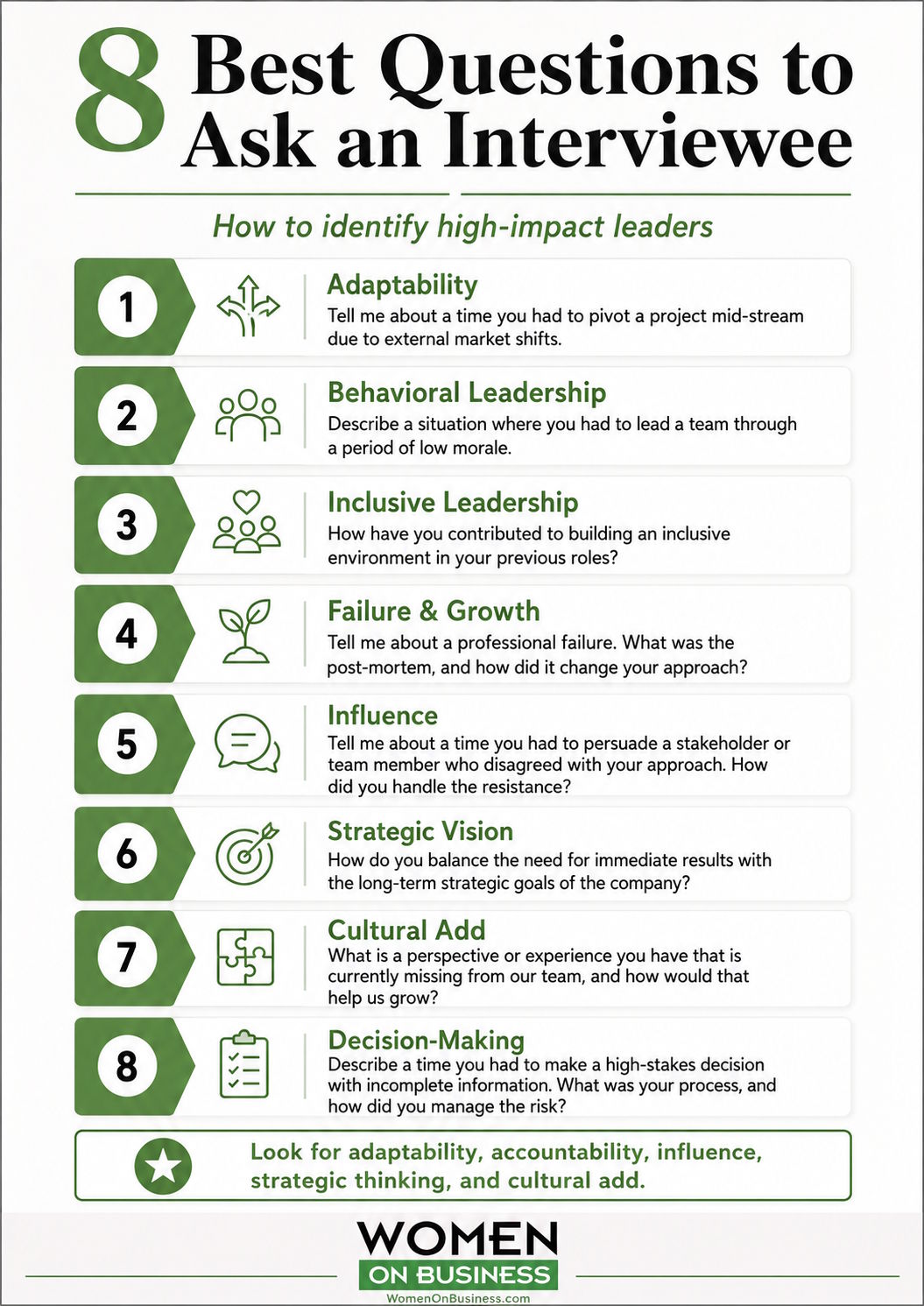
8 Best Questions to Ask an Interviewee
From behavioral interview questions to ask all candidates to specific prompts that serve as the best interview questions for female leaders, these eight questions are designed to uncover the strategic thinkers who will drive your business forward.
1. The ‘Adaptability’ Prompt: Navigating Pivot Points
One of the most revealing — and consistently underused — good questions to ask every interviewee tells you about their ability to adapt to change.
The question to ask: “Tell me about a time you had to pivot a project mid-stream due to external market shifts.”
In growth-stage companies, adaptability often outweighs a static skillset. Markets shift, priorities change, and leaders who cling to the original plan can stall entire organizations.
As Harvard Business Review notes, the best interview questions uncover soft skills — emotional intelligence, adaptability, and cultural contribution — far more effectively than technical queries alone. A candidate who has never been tested by disruption is an unknown quantity.
What to look for in the answer: Strong candidates will demonstrate three distinct signals:
- Resilience: They acknowledge the difficulty without dwelling on it.
- Speed of decision-making: They describe a clear, timely course correction rather than prolonged hesitation.
- Stakeholder communication: They explain how they kept their team and leadership aligned through the uncertainty.
Watch for candidates who default to “we” when describing the pivot — accountability language matters here. That instinct toward precision in storytelling is exactly what the next question type is designed to test.
Takeaway: A candidate’s pivot story reveals more about their leadership ceiling than any hypothetical scenario ever will.
2. The ‘Behavioral’ Anchor: Predicting Future Performance
Choosing the right behavioral interview questions to ask candidates isn’t just good practice — it’s backed by hard data. According to SHRM, behavioral questions are 55% predictive of future on-the-job performance, compared to just 10% for traditional hypothetical questions.
That gap is why “Tell me about a time…” consistently outperforms “What would you do if…” by roughly 5x.
The question to ask: “Describe a situation where you had to lead a team through a period of low morale.”
This prompt forces candidates to draw from real experience rather than construct an idealized response. What you’re listening for isn’t just the outcome — it’s the candidate’s specific actions.
What to look for: Pay close attention to language. Leaders who default to “we implemented” or “the team decided” may be obscuring their individual contribution. The most revealing answers use deliberate “I” statements — “I recognized the disconnect,” “I restructured our check-ins” — which signal genuine ownership rather than borrowed credit.
Strong leaders build institutional knowledge precisely because they understand their role within a team while still driving accountability themselves.
Takeaway: When candidates anchor their answers in specific, first-person action, you’re hearing evidence — not aspiration.
3. The ‘DEI’ Lens: Assessing Inclusive Leadership
A candidate’s relationship with diversity reveals far more than their HR fluency. It exposes their core leadership philosophy.
The question to ask: “How have you contributed to building an inclusive environment in your previous roles?”
What to look for: Listen closely. Checkbox candidates will recite policy compliance. Business-minded leaders will describe specific initiatives, measurable outcomes, and the competitive edge inclusion created for their teams.
This distinction matters enormously. According to Glassdoor, 67% of job seekers say a diverse workforce is an important factor when evaluating companies and job offers — meaning inclusive culture is now a talent acquisition asset, not just an ethical obligation.
A candidate who treats DEI as a growth lever — one who can speak to building stronger team dynamics through diverse perspectives — is demonstrably more equipped to lead in today’s market. Deloitte’s research reinforces that inclusive leaders consistently outperform peers on team retention and innovation metrics.
Takeaway: Prioritize candidates who connect inclusion directly to business results — that’s the difference between a diversity advocate and a true inclusive leader.
4. The ‘Failure’ Audit: Probing for Growth Mindset
Among the top questions to ask an interviewee, the failure prompt is the most revealing.
The question to ask: “Tell me about a professional failure. What was the post-mortem, and how did it change your approach?”
The answer strips away rehearsed polish and exposes whether a candidate views setbacks as threats to their identity or as material for growth. High-potential leaders are able to extract lessons from setbacks rather than avoid them. This capacity for honest self-reflection is also a cornerstone of continuous development at work — a trait that compounds over a leader’s entire tenure.
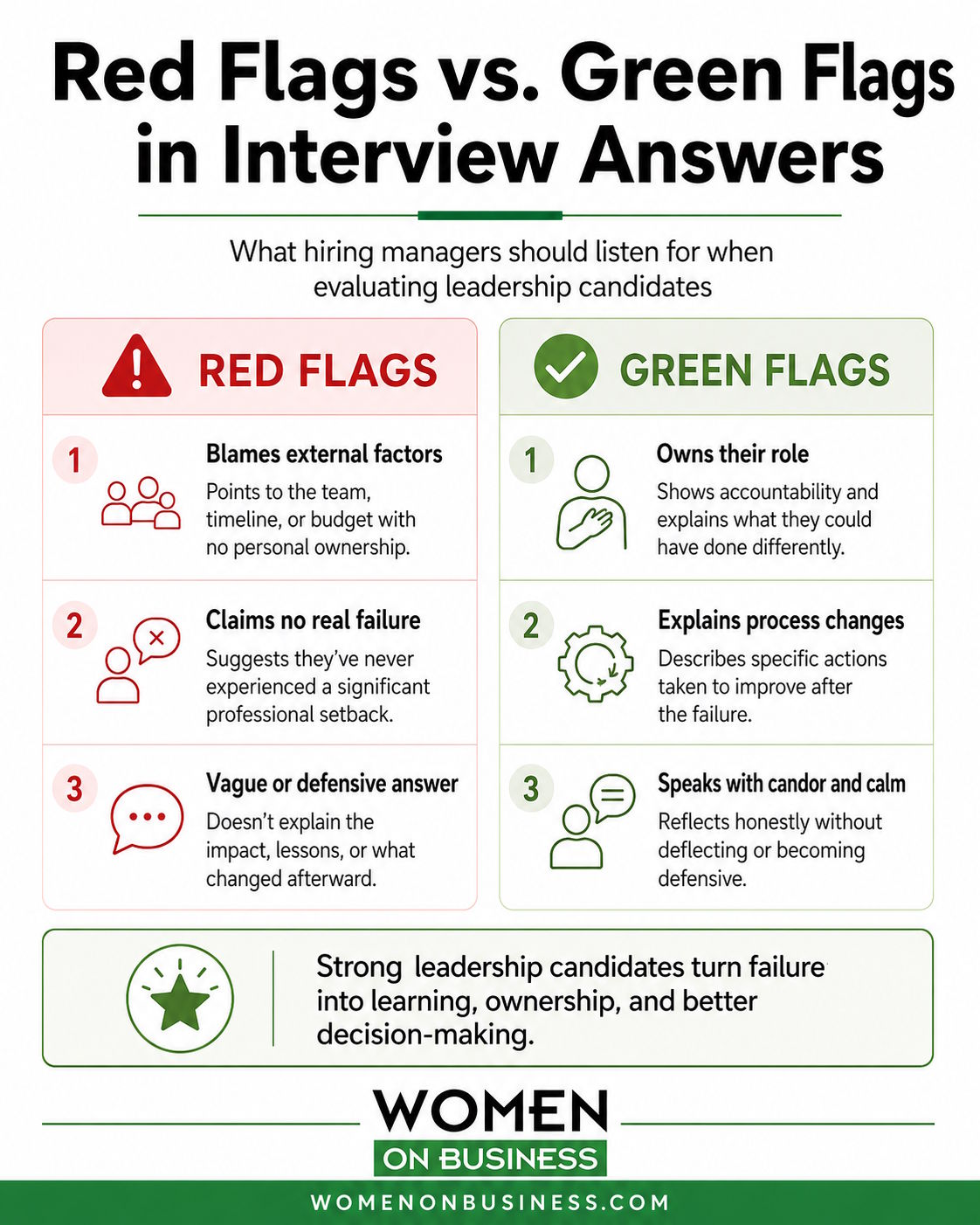
What to look for: Pay attention to the red and green flags introduced below.
Red Flags vs. Green Flags
|
🚩 RED FLAGS |
✅ GREEN FLAGS |
|
Blames external factors — the team, the timeline, the budget — with no personal ownership |
Demonstrates radical accountability — owns the role they played without deflecting |
|
Claims to have never experienced a significant failure |
Articulates specific process changes made as a direct result of the failure |
|
Describes the failure vaguely, without measurable impact or outcome |
Speaks about the experience with candor and calm rather than defensiveness |
Takeaway: If a candidate can walk you through a failure with precision and accountability, they’ve already proven they can lead through the next one.
5. The ‘Influence’ Probe: Leading Without Authority
Behavioral interview questions ask for specific examples of how an interviewee handled situations in the past with the idea that their past behavior will predict their future performance. They’re very effective to help interviewers evaluate a candidate’s character, soft skills, and ability to solve problems. With that said, one of the most effective behavioral interview questions to ask candidates is one that provides information about how they influence others.
The question to ask: “Tell me about a time you had to persuade a stakeholder or team member who disagreed with your approach. How did you handle the resistance?”
This type of question is so important because high-impact leaders rarely operate in a vacuum. Instead, they need to influence peers, cross-functional partners, and sometimes superiors. According to research from Harvard Business Review, the ability to influence without formal authority is a primary differentiator between mid-level managers and true organizational leaders.
What to look for: Look for candidates who focus on active listening and finding common ground. It’s a red flag if the interviewee describes “winning” the argument. On the other hand, it’s a green flag is they describe understanding the other person’s views and creating a solution together.
Takeaway: A candidate’s answer to this question reveals a lot about their emotional intelligence and their ability to build consensus rather than relying on positional power.
6. The ‘Strategic Vision’ Question: Connecting Dots
To identify candidates who think beyond their immediate tasks you need to ask probing questions to understand their ability to think strategically.
The question to ask: “How do you balance the need for immediate results with the long-term strategic goals of the company?”
High-impact leaders must be able to embrace the organization’s strategic vision. A study by McKinsey & Company highlights that high-impact leaders are distinguished by their ability to allocate resources toward long-term value creation while maintaining operational excellence.
What to look for: Strong candidates will provide examples of how they prioritized a project that didn’t offer immediate gratification but provided significant long-term ROI or efficiency gains. They should demonstrate an understanding of how their specific role impacts the company’s bottom line.
Takeaway: Asking this question gives you the chance to determine if the interviewee understands the “big picture.”
7. The ‘Cultural Add’ Inquiry: Expanding the Horizon
For those seeking the best interview questions for female founders and leaders focused on diversity, focus on learning not just about cultural fit but also cultural add.
The question to ask: “What is a perspective or experience you have that is currently missing from our team, and how would that help us grow?”
This shifts the conversation from “culture fit”—which often leads to hiring people who think and act like the existing team—to cultural add. Research from Deloitte confirms that inclusive teams that prioritize diverse perspectives are more innovative and better equipped to solve complex problems. This question forces the candidate to articulate their unique value proposition.
What to look for: Candidates who’ve done their research on your company and can identify a genuine gap in the team’s current makeup or approach.
Takeaway: A good answer to this question signals high self-awareness and a proactive mindset.
8. The ‘Decision-Making’ Stress Test: Navigating Ambiguity
The final essential prompt enables the interviewer to gain insight about the interviewees ability to handle pressure and make decisions even when the timing and information available aren’t perfect.
The question to ask: “Describe a time you had to make a high-stakes decision with incomplete information. What was your process, and how did you manage the risk?”
In fast-paced, growth-oriented environments, leaders are rarely afforded the luxury of perfect data. According to Forbes, the ability to navigate ambiguity is a core competency for modern leadership.
What to look for: A clear, logical framework for decision-making.
- Do they consult experts?
- Do they establish a “point of no return”?
- Do they have a plan for course correction if the decision proves wrong?
You’re looking for a balance of decisiveness and humility.
Takeaway: This is among the top questions to ask an interviewee because it reveals their comfort level with uncertainty and their methodology for risk mitigation.
The ‘Reverse’ Interview: What Interviewees’ Questions Reveal
The candidate’s questions aren’t a formality — they’re a diagnostic tool. High-impact leaders arrive prepared with deliberate, forward-thinking questions that signal self-awareness, strategic orientation, and genuine investment in the role.
Reserving at least 15 minutes at the end of your interview for this “reverse” vetting pays dividends because the quality of what a candidate asks tells you as much as the quality of what they answer.
According to Harvard Business Review, smart candidates ask specifically about the most important outcomes to achieve in the first 90 days — a question that signals they’re already thinking in terms of execution, not just impression management. Pair that with their curiosity about team dynamics and culture and you start to see a leader, not just a job-seeker.
Listen for these five high-signal questions from your candidate:
- “What does success look like in the first 90 days?” — Shows execution mindset
- “What’s the biggest challenge the team is currently navigating?” — Reveals problem-solving orientation
- “How does leadership here define and model accountability?” — Probes cultural values, not just surface perks
- “What’s prevented previous candidates from excelling in this role?” — Signals self-awareness and risk assessment
- “How does this role evolve over 18–24 months?” — Demonstrates long-term thinking over short-term opportunism
The best candidates treat the interview as a two-way evaluation — and your job is to recognize that ambition as a strength, not a threat.
Building a Winning Career and Brand
The eight questions explored throughout this article share a common thread. Great leaders are ultimately defined by the quality of the teams they build, the trust they cultivate, and the results they inspire in others. No single interview question will provide all of that information, but a structured, deliberate set of probes — covering failure, vision, accountability, and culture — transforms hiring from a guessing game into a repeatable discipline.
As you refine your own interview framework, consider how each question opens a window that standard résumé reviews simply cannot. Building a high-performing team is also about supporting the whole employee — recognizing that leadership extends well beyond the hiring conversation.
Bottom-line, the best hiring decisions aren’t made in the moment — they’re built on the right questions asked before the offer is ever extended.
Frequently Asked Questions
What are the best questions to ask an interviewee to identify leadership potential?
The best questions to ask an interviewee focus on past behaviors rather than hypothetical scenarios. To identify high-impact leaders, ask about specific instances where they navigated a pivot, managed low team morale, or extracted lessons from a significant professional failure. These responses provide evidence of adaptability and accountability.
Why are behavioral interview questions to ask candidates more effective?
Behavioral interview questions to ask candidates are approximately 55% predictive of future job performance, whereas traditional hypothetical questions are only 10% predictive. By asking “Tell me about a time…” instead of “What would you do if…”, you force the candidate to draw from real-world experience, making it harder to provide rehearsed, idealized answers.
What are the best interview questions for female business owners to use when hiring?
For women business owners building inclusive and high-growth teams, the best interview questions test for “cultural add” rather than just “cultural fit.” Questions should probe how a candidate has contributed to inclusive environments and how they handle the rapid pivots common in startups and owner-led organizations.
What are the top questions to ask an interviewee at the end of the interview?
The top questions to ask an interviewee include those that test for a “growth mindset” and strategic orientation. However, pay close attention to the questions the candidate asks you. Questions about 90-day success metrics, current team challenges, and long-term role evolution are high-signal indicators of a prepared and high-impact leader.