
Improving work performance doesn’t mean just asking people to work harder. In many cases, figuring out how to improve work performance comes from creating clearer expectations, removing unnecessary obstacles, providing useful support, and helping people focus their energy where it matters most.
That’s especially important for women business owners, who are often balancing leadership, client relationships, financial decisions, team management, and day-to-day operations at the same time. When your schedule is already full, pushing yourself or your employees to do more without changing how the work gets done can quickly lead to frustration and burnout.
A more effective approach is to examine the conditions that influence performance.
Do employees understand what success looks like? Are priorities clear? Do people have the skills, tools, time, and feedback they need? Does the workplace encourage collaboration, or does it create unnecessary stress?
When these factors are addressed, businesses can improve productivity without sacrificing employee well-being. The result is often stronger performance, better morale, higher-quality work, and a more sustainable way of operating.
Key Takeaways
- Strong work performance begins with clear, measurable goals that support the company’s larger objectives.
- Better time management requires prioritization, not simply fitting more tasks into the day.
- A positive work environment can improve collaboration, engagement, and employee retention.
- Professional development helps employees strengthen current skills and prepare for greater responsibilities.
- Work-life balance supports consistent performance by reducing exhaustion and chronic stress.
- Constructive feedback should be specific, timely, and focused on helping people improve.
Why Work Performance Matters
Work performance affects nearly every part of a business.
When employees perform well, customers receive better service, projects move forward more efficiently, and leaders spend less time correcting mistakes or managing preventable problems. Strong performance can also improve profitability by reducing wasted time, missed deadlines, duplicated effort, and employee turnover.
However, work performance shouldn’t be measured only by how many tasks someone completes.
High performance also includes the quality of the work, the employee’s ability to solve problems, how well the person collaborates with others, and whether their work contributes to the company’s goals. An employee who completes a large volume of work but regularly creates errors or disrupts the team may not be performing as effectively as the numbers suggest.
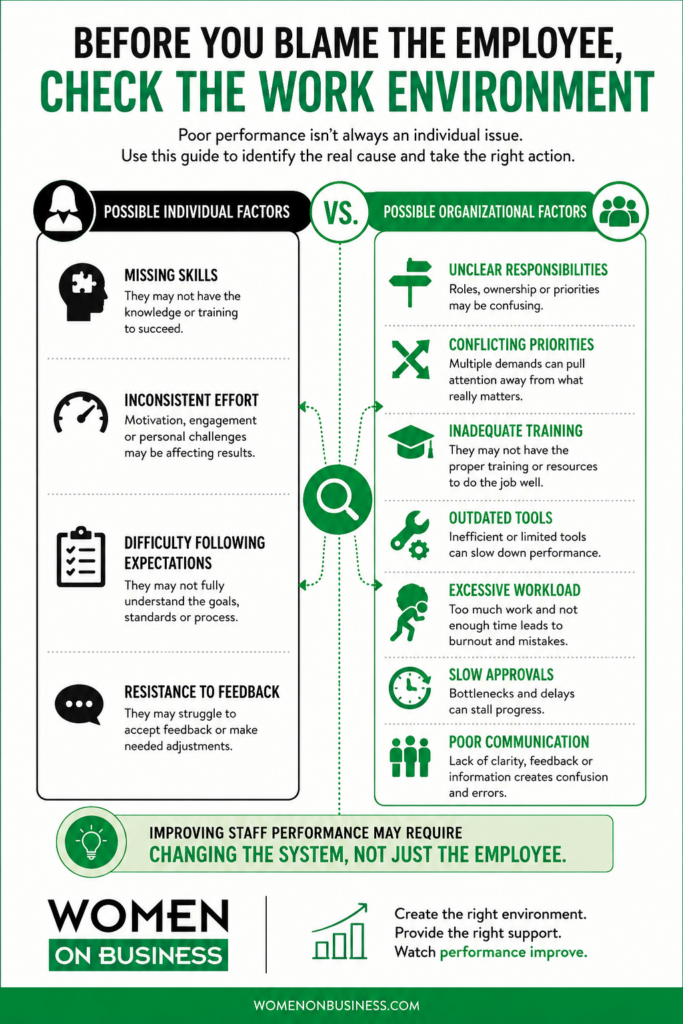
Business owners should also distinguish between an individual performance problem and a workplace problem.
For example, an employee may appear unproductive because priorities change constantly, approval processes are slow, or responsibilities haven’t been clearly defined. Another employee may struggle because they were never properly trained on a system they’re expected to use.
Before assuming someone lacks motivation, look at the full picture. Improving staff performance often requires leaders to improve systems, communication, and expectations.
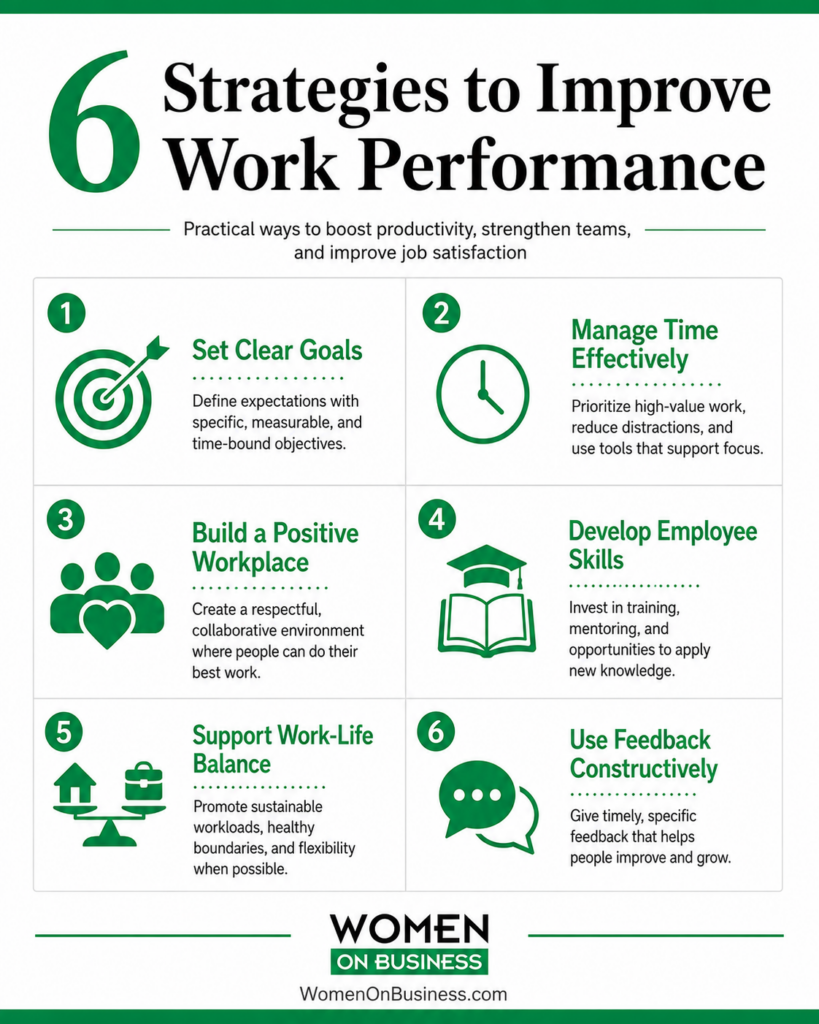
How to Improve Work Performance: Strategies Overview
There is no single technique that will improve performance in every business. The most effective approach combines several strategies that address both individual habits and workplace conditions.
Business owners can start by focusing on six areas:
- Setting clear goals
- Improving time management
- Creating a positive work environment
- Investing in professional development
- Promoting work-life balance
- Using feedback effectively
These strategies can create an environment that better equips employees to succeed.
Strategy 1: Set Clear Goals
Employees are more likely to perform well when they understand what they’re expected to accomplish and why their work matters.
Vague instructions such as “increase engagement,” “improve customer service,” or “be more productive” don’t give people enough direction. Employees may interpret those goals differently, which makes it difficult to prioritize work or evaluate progress.
Clear goals provide a shared definition of success.
They also make performance conversations more objective. Instead of relying on general impressions, managers and employees can discuss progress using specific expectations, milestones, and results.
Define SMART Goals
One of the most familiar goal-setting frameworks is the SMART method. The U.S. Office of Personnel Management also recommends using SMART goals as part of an effective performance-management process.
SMART goals are:
- Specific
- Measurable
- Achievable
- Relevant
- Time-bound
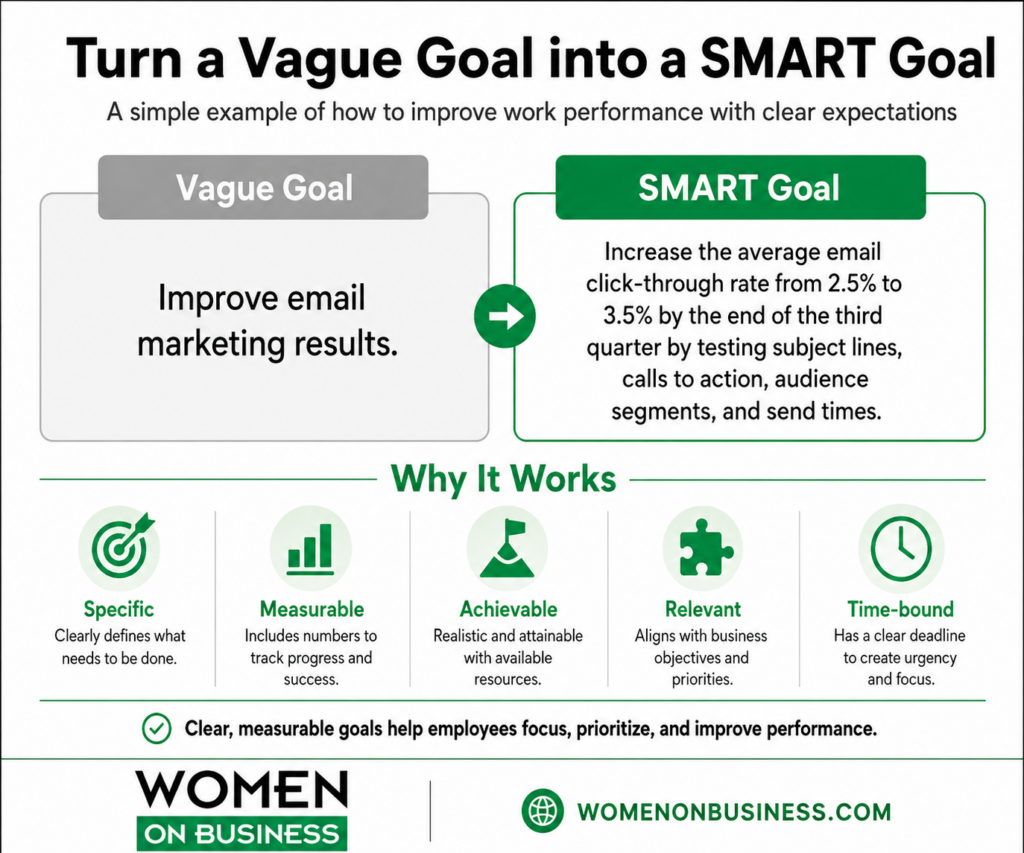
For example, “improve email marketing results” is too broad to guide daily decisions.
A stronger goal would be: “Increase the average email click-through rate from 2.5% to 3.5% by the end of the third quarter by testing subject lines, calls to action, audience segments, and send times.”
This version explains what needs to improve, how success will be measured, and when the result should be achieved.
SMART goals can be useful for individual employees, departments, and the company as a whole. However, avoid using the framework so rigidly that employees become focused only on numbers.
Goals should support good judgment and meaningful outcomes, not encourage people to chase metrics at the expense of quality.
Align Goals With Company Objectives
Individual goals should connect to larger business priorities.
When employees understand how their responsibilities contribute to the company’s direction, their work often feels more meaningful. They can also make better decisions when competing tasks arise.
Suppose one of your company’s primary objectives is to improve customer retention. Relevant employee goals might include reducing response times, improving onboarding, identifying common customer complaints, or creating a process for following up with inactive clients.
Each goal supports the broader objective in a different way.
This alignment also helps prevent employees from spending too much time on activities that look productive but don’t create significant business value.
When setting goals, explain the reasoning behind them. People are more likely to commit to a target when they understand why it matters.
Strategy 2: Enhance Time Management
Time management is both a personal discipline and an organizational responsibility. Think of it this way – mployees can use calendars, task lists, and productivity methods, but those tools won’t solve problems caused by conflicting priorities, excessive meetings, unclear responsibilities, or constant interruptions.
To increase work performance, examine how time is being used across the business.
Are employees attending meetings that don’t require their participation? Are they repeatedly answering the same questions because information isn’t documented or easily accessible? Are projects delayed because every decision requires approval from one person?
Removing these obstacles could improve productivity more than introducing another time-management application.
Tools for Effective Time Management
The right tools can make work easier to organize and track. Depending on the size and needs of your business, useful options may include:
- Digital calendars for scheduling focused work and important deadlines
- Project management platforms for tracking tasks, owners, and progress
- Time-tracking tools for identifying where hours are being spent
- Shared documents for reducing unnecessary emails and repeated questions
- Automated reminders for recurring tasks and follow-ups
- Communication platforms that keep project discussions organized
The best tool is one that employees will actually use consistently. A complicated system with dozens of features could create more work than it eliminates.
Before adopting new software, define the specific problem you’re trying to solve. Then choose the simplest tool that addresses it.
Prioritization Techniques
Employees can be busy all day without making meaningful progress. That usually happens when urgent requests, minor tasks, and frequent interruptions take attention away from higher-value work.
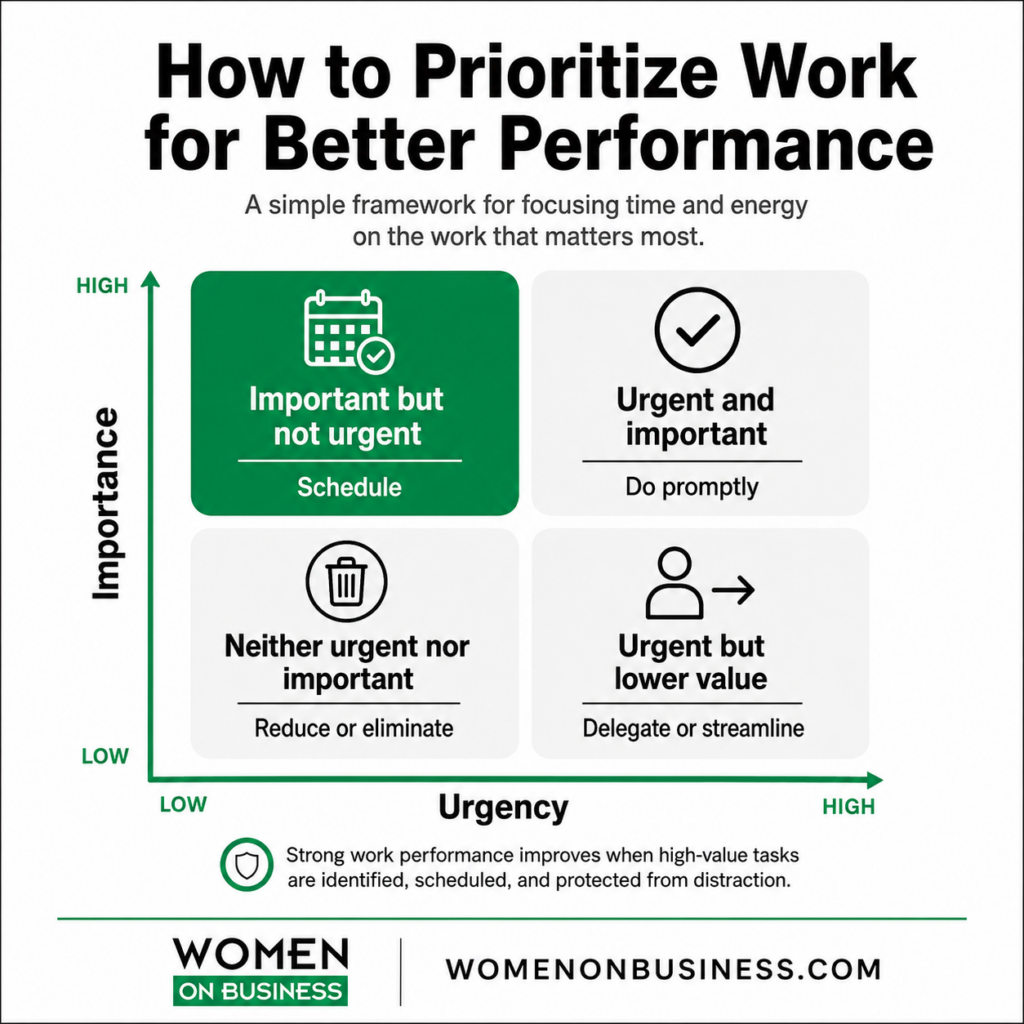
One practical technique is to categorize tasks based on urgency and importance:
- Urgent and important tasks should be addressed promptly.
- Important but nonurgent tasks should be scheduled before they become emergencies.
- Urgent but low-value tasks may be delegated or streamlined.
- Tasks that are neither urgent nor important may need to be reduced or eliminated.
Another approach is to identify one to three essential outcomes for the day. These are the tasks that deserve attention even if less important work remains unfinished.
For business owners, prioritization also means becoming comfortable with delegation. Holding onto every responsibility may feel efficient in the moment, but it limits growth and can prevent employees from developing their capabilities.
Strategy 3: Foster a Positive Work Environment
In a positive work environment, people are treated fairly, communicate respectfully, and feel comfortable contributing ideas or raising concerns. Furthermore, employees perform better when they can focus on their work instead of navigating unnecessary tension, unclear expectations, or fear of being blamed for honest mistakes.
Leaders set the tone.
How you respond to problems, disagreements, and feedback influences how employees communicate with one another. If leaders become defensive or punitive, employees may stop sharing important information. If leaders listen and respond thoughtfully, employees are more likely to speak up before small problems become expensive ones.
Create a Collaborative Culture
Collaboration improves when employees know who is responsible for what and have reliable ways to share information.
To support collaboration:
- Define roles and decision-making authority.
- Make project information accessible to the people who need it.
- Encourage employees to share ideas before plans are finalized.
- Address conflict directly rather than allowing resentment to grow.
- Give quieter team members opportunities to contribute.
- Avoid creating unnecessary competition between employees or departments.
Collaboration doesn’t require everyone to participate in every decision. In fact, too much collaboration can slow work down. Instead, the goal is to involve the right people at the right time while making responsibilities clear.
Recognize and Reward Achievements
Recognition shows employees that their contributions are noticed.
It doesn’t always require a formal award or financial bonus. A specific thank-you, a positive comment during a team meeting, or a message acknowledging a job well done can reinforce strong performance.
Effective recognition explains what the employee did and why it mattered.
Instead of saying, “Great job,” you might say, “Your preparation for the client meeting helped us answer every concern clearly. The client specifically mentioned how confident they felt about moving forward.”
That type of recognition is more meaningful because it connects the employee’s actions to a business result.
Whenever possible, make recognition fair and consistent. Repeatedly praising the most visible employees while overlooking behind-the-scenes contributions can damage morale.
Strategy 4: Invest in Professional Development
Employees can’t improve their job performance if they’re expected to develop new skills without instruction, resources, or practice.
Professional development gives people the opportunity to strengthen their skills, prepare for changing responsibilities, and pursue broader career advancement opportunities. It also communicates that the company sees potential in them.
For small businesses, development doesn’t have to involve expensive conferences or extensive training programs. It can include mentoring, online courses, job shadowing, stretch assignments, peer learning, or time to study a new tool.
Identify Training Opportunities
Start by identifying gaps between the skills employees currently have and the skills the business needs.
Those gaps may become visible through performance reviews, customer feedback, quality problems, employee questions, or upcoming business plans.
For example, if the company plans to expand its digital marketing, employees may need training in analytics, content strategy, advertising platforms, or marketing automation. If customer complaints frequently involve inconsistent service, communication or process training may be more valuable.
Ask employees where they feel less confident and what they’d like to learn. They may be aware of obstacles that aren’t obvious to the management team.
Encourage Skill Development
Training is most valuable when employees have opportunities to apply what they learn.
After a course or workshop, assign a related project, encourage the employee to teach key lessons to the team, or create a plan for using the skill in their role.
Managers should also provide room for experimentation. Employees won’t become confident using a new skill when every early attempt is expected to be perfect.
Professional development can support retention as well. Employees are more likely to imagine a future with the company when they can see opportunities to learn, grow, and take on greater responsibility.
Strategy 5: Promote Work-Life Balance
Working longer hours doesn’t always produce better results. After a certain point, fatigue reduces concentration, creativity, patience, and accuracy. Employees complete more hours of work but produce lower-quality results.
Work-life balance helps people maintain the energy needed to perform consistently. It doesn’t mean there are never times when extra hours might be necessary. The problem is when excessive pressure and long hours become the normal operating condition.
Business owners should also learn to recognize the warning signs of work burnout before chronic stress begins affecting health, morale, and performance. According to the National Institute for Occupational Safety and Health, stressful working conditions directly affect employee health and workplace performance, making organizational changes an important part of addressing job stress
Benefits of Work-Life Balance
Healthy boundaries can contribute to:
- Better focus and decision-making
- Fewer preventable mistakes
- Improved morale
- Lower risk of burnout
- Stronger employee retention
- More consistent productivity
- Better physical and emotional well-being
Business owners benefit from these boundaries too. Entrepreneurs sometimes treat exhaustion as proof of commitment, but chronic overwork can weaken judgment and make even routine decisions feel difficult. Protecting your time can make you a more effective leader.
Strategies to Achieve Balance
Work-life balance will look different depending on the employee, role, and business. Practical strategies may include:
- Setting realistic deadlines
- Limiting after-hours messages
- Encouraging employees to use vacation time
- Offering flexible schedules when possible
- Monitoring workloads across the team
- Cross-training employees so one person isn’t responsible for every urgent task
- Reducing unnecessary meetings
- Establishing clear expectations for availability
Leaders should model the behavior they want employees to follow.
Telling employees to disconnect but you continue to send messages late at night creates an unspoken expectation that they should remain available to respond. Scheduling emails for the next workday or clearly stating that no immediate response is expected helps protect those boundaries.
Strategy 6: Utilize Feedback Effectively
Feedback is one of the most valuable tools for improving performance but only when it’s delivered thoughtfully. Regular feedback creates opportunities for small corrections before performance issues become serious.
Employees need to know what they’re doing well, where adjustments are needed, and what steps they can take next. Waiting until an annual review to discuss problems gives those problems too much time to grow.
Importance of Constructive Feedback
Constructive feedback should be specific, timely, and focused on behavior or results rather than personality.
For example, telling an employee, “You need to be more professional,” is vague and likely to feel personal. A more useful version would be, “During yesterday’s client call, the client asked two questions that weren’t answered before the conversation moved forward. In future calls, pause after each question and confirm that the client has the information they need.”
The second version identifies the behavior, explains its impact, and provides a clear next step.
Feedback should also include positive observations. Employees need to understand which behaviors are effective so they can repeat them.
How to Solicit and Implement Feedback
Business owners and managers should be willing to receive feedback as well as provide it.
Ask employees questions such as:
- What is slowing down your work?
- Which responsibilities are unclear?
- What process creates the most frustration?
- What could I do differently to support you?
- Which tools or resources would make your job easier?
- Is there work we’re doing that no longer seems useful?
Employees may not answer honestly if leaders react defensively. Thank people for their input, ask questions to understand the issue, and avoid immediately explaining why the concern is wrong.
You don’t have to act on every suggestion. However, you should acknowledge the feedback and explain what will happen next.
When you decide to make a change, identify the action, assign responsibility, and follow up. Collecting feedback without addressing it can make employees less willing to participate in the future.
Frequently Asked Questions About How to Improve Work Performance
What are three ways to improve work performance?
Three effective ways to improve work performance are to set clear goals, prioritize high-value tasks, and request regular feedback. Clear goals provide direction, prioritization protects time for important work, and feedback helps identify adjustments before small issues become larger problems.
How can I improve my own performance at work?
Start by identifying the responsibilities that contribute most directly to your role and the company’s goals. Set measurable targets, protect focused work time, reduce distractions, and ask your manager or colleagues for specific feedback. Choose one or two areas to improve rather than trying to change every habit at once.
What factors negatively affect job performance?
Common factors include unclear expectations, poor communication, inadequate training, conflicting priorities, excessive workloads, lack of recognition, outdated tools, workplace conflict, and limited feedback. Personal circumstances can also affect performance, so managers should approach concerns with both accountability and empathy.
What can employers do to improve job satisfaction?
Employers can improve job satisfaction by offering fair treatment, meaningful recognition, opportunities for development, reasonable flexibility, clear communication, and manageable workloads. Employees are also more likely to feel satisfied when they understand how their work contributes to the organization.
How long does it take to improve work performance?
The timeline depends on the cause of the performance problem and the changes being made. Some improvements, such as clarifying priorities or removing unnecessary meetings, may produce quick results. Skill development and major behavioral changes usually require more time, practice, and consistent feedback.
How to Improve Work Performance? Build Better Conditions for Stronger Performance
Learning how to improve work performance requires more than a single productivity trick or expecting employees to operate at maximum capacity every day.
Sustainable performance comes from building a workplace where people understand what matters, have the resources to do their jobs, receive useful feedback, and can maintain the energy required to produce quality work.
Begin by identifying the most significant obstacle to high performance in your business. It may be unclear goals, inefficient processes, limited training, weak communication, or an unsustainable workload.
Address that issue first. Then measure the results and continue making thoughtful adjustments.
Small operational improvements can create meaningful changes over time. When leaders improve the conditions surrounding the work, employees are in a much stronger position to improve the work itself.
