
Artificial intelligence can summarize reports, analyze data, draft emails, create presentations, and complete many routine business tasks in seconds. As these tools improve, workers are understandably concerned about how automation could affect their careers.
For women in business, the issue deserves particular attention. Women are highly represented in administrative, clerical, customer service, marketing, human resources, and business support roles where AI can automate a growing number of tasks. However, automation doesn’t necessarily mean that entire occupations will disappear. In many cases, AI will change how jobs are performed and which abilities employers value most.
That shift creates an important opportunity.
Women who understand which abilities and occupations are most resistant to automation can make more informed career decisions. This includes exploring AI-resistant careers in 2026 and beyond and identifying the human capabilities those roles require.
Professionals who strengthen the abilities needed to interpret information, communicate effectively, recognize problems, and exercise sound judgment can become more valuable as routine work moves to technology. Instead of competing with AI on speed, they can focus on work that requires context, trust, accountability, and human understanding.
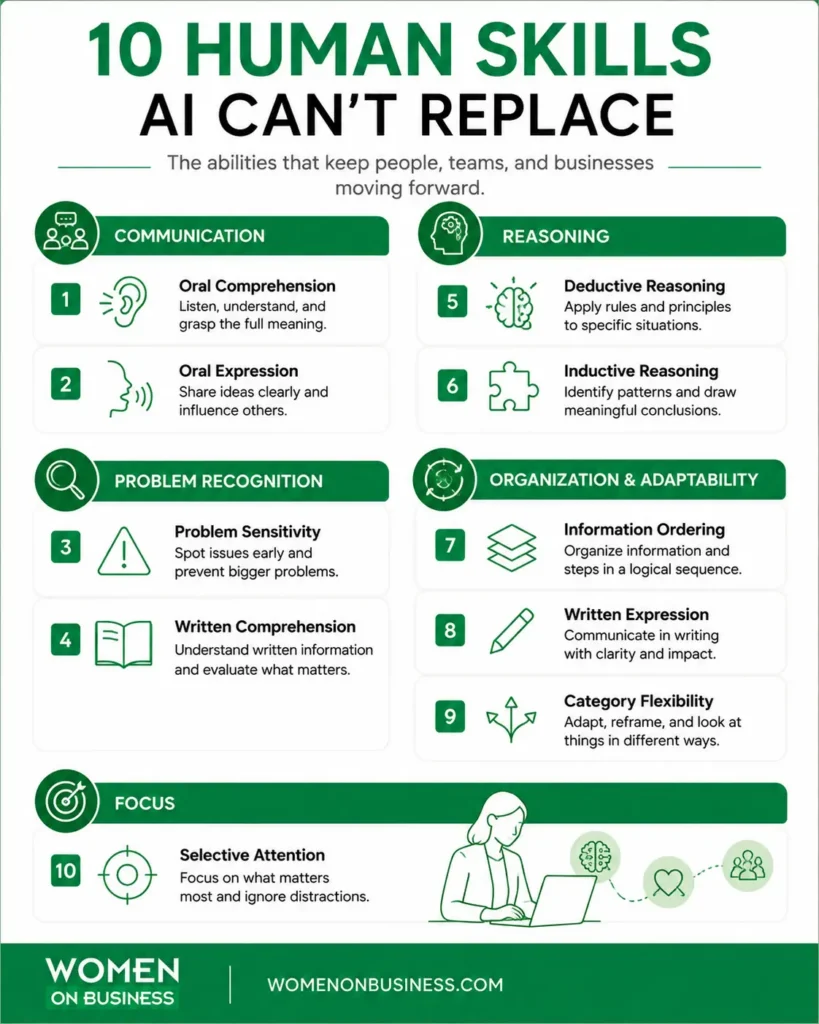
A Resume Now study used occupational data from O*NET to identify 10 cognitive abilities that are broadly important across 894 occupations. The report describes them as skills AI can’t replace. It may be more accurate to say these abilities are difficult for AI to replicate completely, particularly when they need to be used in unpredictable human situations.
These skills shouldn’t be viewed simply as keywords to add to a resume. They’re career-building capabilities that women can deliberately improve to qualify for more responsibility, contribute to better decisions, and remain valuable as technology reshapes the workplace.
Key Takeaways
- Communication-related abilities account for four of the 10 highest-rated human skills in the Resume Now research.
- Reasoning, problem recognition, organization, adaptability, and concentration also remain important across hundreds of occupations.
- Women may face greater exposure to AI because they’re highly represented in administrative and business support positions.
- Human skills become more valuable when they contribute to decisions, relationships, risk management, and measurable business results.
- Career resilience will increasingly depend on combining human judgment with the ability to use AI effectively.
What the Research Found
Resume Now analyzed O*NET importance ratings for 21 cognitive abilities across 894 occupations. O*NET rates the importance of each ability on a scale from one to five. The study highlighted the 10 abilities that earned an average importance score of at least three.
The highest-rated abilities were oral comprehension, oral expression, problem sensitivity, written comprehension, and deductive reasoning. The remaining five were inductive reasoning, information ordering, written expression, category flexibility, and selective attention.
Four of the 10 abilities involve understanding or communicating information. Several others relate to recognizing problems, applying logic, identifying patterns, organizing work, and staying focused.
The findings are consistent with broader workforce research. The World Economic Forum has reported that employers expect analytical thinking, resilience, flexibility, leadership, and collaboration to remain important even as demand for AI and technology skills grows.
Bottom-line, learning to use AI is important, but technical proficiency alone won’t provide long-term career security. Workers also need the human abilities required to evaluate AI-generated information, apply it responsibly, and communicate what should happen next.
1. Oral Comprehension
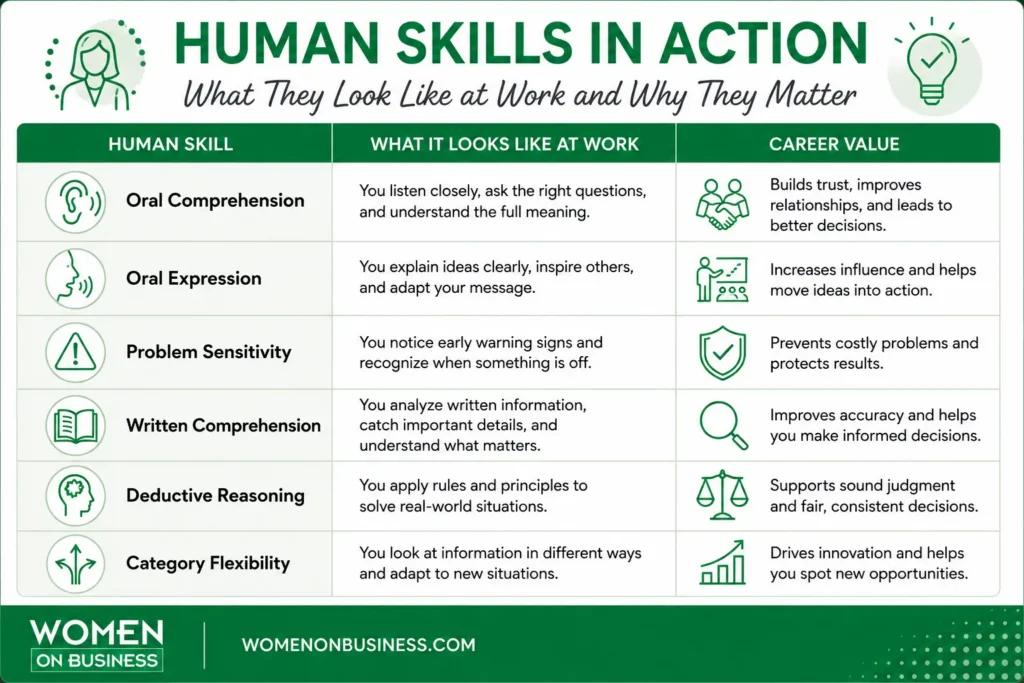
Oral comprehension is the ability to listen to and understand information communicated through speech. It received the highest average importance score in the Resume Now study.
AI can transcribe a meeting and summarize what participants said. It may still miss hesitation, conflicting priorities, sarcasm, uncertainty, or an important concern that someone expresses indirectly. Human listeners use knowledge of the people involved, the history of the situation, and changes in tone or behavior to interpret the full message.
Imagine that a client describes a proposal as interesting but repeatedly asks about implementation risks. A strong listener recognizes that the client may not need more information about the benefits. The real concern is whether the change can be introduced without disrupting the organization.
How to Improve
You can improve oral comprehension by removing distractions during important conversations and taking brief notes. Ask follow-up questions instead of assuming that you understand. Restate key points in your own words and give the other person an opportunity to correct your interpretation.
After a meeting, compare your understanding with the decisions and actions that follow. This can reveal whether you’re hearing the complete message or simply recording the words being spoken.
2. Oral Expression
Oral expression is the ability to communicate ideas clearly through speech. It ranked second in the study.
AI can generate talking points, presentation outlines, and suggested responses. It can’t take personal responsibility for a recommendation or adjust its credibility based on a long-standing relationship with the audience. Business communication often requires responding to resistance, changing an explanation in real time, and addressing concerns that weren’t anticipated.
How to Improve
You can strengthen oral expression by practicing short explanations of complex topics. Try presenting the same recommendation in one minute, three minutes, and 10 minutes. This forces you to identify what matters most and adjust the amount of detail for different audiences.
Recording yourself can also help. Listen for unclear wording, unnecessary detail, unsupported claims, or sentences that are difficult to follow.
Look for opportunities to lead project updates, facilitate meetings, train colleagues, or present findings. These experiences help you develop the confidence and judgment required to communicate when the outcome matters.
Because communication accounts for several of the most important skills identified in the research, it’s worth taking deliberate steps to improve your business communication skills.
3. Problem Sensitivity
Problem sensitivity is the ability to recognize that something is wrong or likely to go wrong. It doesn’t necessarily mean knowing how to fix the problem immediately. The value often comes from noticing warning signs before a situation becomes more serious.
AI can identify anomalies when it has enough reliable data and clearly defined parameters. Many workplace problems are less obvious.
A manager might notice that a dependable employee has become unusually quiet. A sales professional may recognize that customers are asking slightly different questions. A project leader could hear uncertainty in status updates even though the formal reports remain positive.
How to Improve
Develop problem sensitivity by looking for weak signals rather than waiting for a failure. Ask what has changed, which assumptions haven’t been tested, and what could prevent the desired outcome.
A decision journal can help improve this skill. Record important decisions, expected results, possible risks, and early concerns. Review those notes later to identify which warning signs you recognized and which ones you overlooked.
4. Written Comprehension
Written comprehension is the ability to understand information presented in writing.
AI can summarize a contract, research paper, financial report, or company policy. The person using the summary must still determine whether important qualifications were omitted, whether the source is credible, and how the information applies to the organization.
How to Improve
Business professionals can improve written comprehension by reading beyond familiar topics. Review industry reports, financial statements, research findings, technical documentation, and policies that affect your work.
After reading an important document, identify its main claim, supporting evidence, limitations, and practical implications. Ask what the document proves and what it doesn’t prove.
When using AI to summarize material, compare the summary with the original. Look for missing exceptions, conditions, uncertainty, or context. This exercise improves your comprehension and teaches you how to supervise AI output more effectively.
5. Deductive Reasoning
Deductive reasoning involves applying a general rule, policy, or principle to a specific situation.
An AI tool can identify relevant policies or recommend a standard response. Real situations don’t always fit neatly into established categories. Someone must decide which rule applies, whether an exception is justified, and what consequences could follow.
For example, a company may have a standard refund policy. A customer’s unusual circumstances might require a decision that considers consistency, cost, reputation, fairness, and the future value of the relationship.
How to Improve
Practice deductive reasoning by making the logic behind your recommendations clear. State the rule or principle involved, explain how it applies, and identify any facts that could change your conclusion.
Business case studies and post-project reviews are useful because they allow you to examine whether decisions followed logically from the available evidence.
6. Inductive Reasoning
Inductive reasoning is the ability to connect pieces of information, identify patterns, and form a broader conclusion.
AI is highly effective at identifying statistical patterns. Humans still provide context and decide whether a pattern is meaningful.
A decline in sales might appear to be a pricing problem. Conversations with customers, support requests, competitor activity, and website behavior could suggest that unclear positioning is the real cause. Reaching that conclusion requires combining quantitative and qualitative evidence.
How to Improve
Strengthen inductive reasoning by comparing information from several sources. Before accepting an explanation, consider at least two alternatives. Ask which evidence supports each possibility and what additional information would confirm or weaken your conclusion.
You can also practice by reviewing past decisions. Look at the information that was available at the time and determine whether the conclusions were reasonable or based on assumptions.
7. Information Ordering
Information ordering is the ability to arrange information or actions in a logical sequence.
AI can create a project plan, process, or checklist. It may not fully understand informal dependencies, internal politics, staffing limitations, or the order of steps most likely to build support.
Consider a company introducing new software. Technical installation may appear to be the first step. An experienced leader might recognize that explaining the reason for the change, consulting affected employees, and preparing training should happen earlier.
How to Improve
You can improve this skill by mapping recurring processes. Identify each step, the person responsible, the information required, and what happens when a step is delayed.
Review completed projects to find sequencing problems. A missed deadline may have resulted from poor performance, but it also may have occurred because an approval, resource, or decision was scheduled too late.
8. Written Expression
Written expression is the ability to communicate information and ideas clearly in writing.
Generative AI can produce polished sentences quickly. Valuable business writing still requires purpose, audience awareness, factual accuracy, and judgment. A grammatically correct message can create confusion or damage trust when it ignores the situation it will be received in.
How to Improve
Improve your writing by beginning with the outcome the reader needs. Determine what the reader should understand, decide, or do after reading the message.
Organize the information around that goal. Remove unnecessary language and support important claims with evidence. Review the message from the reader’s perspective before sending it.
Pay attention to the responses your writing produces. Did the reader understand the request? Did the proposal lead to a decision? Did employees interpret the policy correctly? Effective writing should be judged by what happens after someone reads it.
9. Category Flexibility
Category flexibility is the ability to organize information in different ways or apply different classification systems.
This skill supports adaptability and creative problem-solving. A marketing leader might segment customers by industry, purchase behavior, profitability, product interest, or readiness to buy. Each method can reveal different opportunities.
AI can recommend categories based on the available data. Humans decide which categories are useful for a particular decision and when an established framework has become too restrictive.
How to Improve
Build category flexibility by deliberately reorganizing the same information in several ways. Group a list of projects by urgency, revenue impact, risk, customer value, or required effort.
Ask how someone in another department might view the information. Exposure to different business functions, industries, and professional perspectives makes it easier to recognize alternative approaches.
10. Selective Attention
Selective attention is the ability to concentrate on a task despite distractions.
AI can process information continuously. Humans determine where attention should be directed. That decision has become more difficult as notifications, meetings, dashboards, messages, and AI-generated content compete for focus.
How to Improve
Protect periods of uninterrupted time for tasks that require analysis, writing, planning, or judgment. Turn off unnecessary notifications, close unrelated applications, and define a specific result for each work session.
You can also improve selective attention by reducing unnecessary task switching. Group similar activities and establish set times for checking messages. Pause before responding to every new request so urgency doesn’t automatically control your schedule.
The goal is to direct your attention deliberately rather than allowing the most recent interruption to decide what receives your focus.
How to Turn Human Skills into Career Opportunities
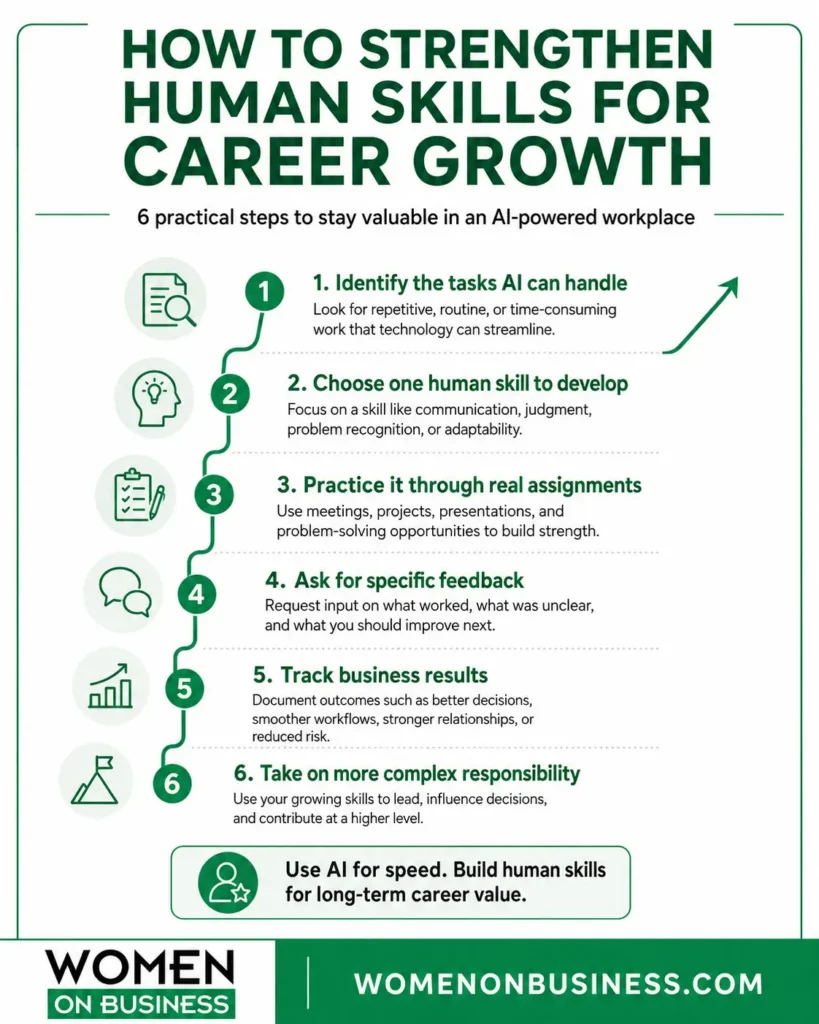
Developing human skills doesn’t require rejecting AI. The stronger career strategy is to use technology for speed while increasing the value of your judgment.
Start by identifying which parts of your role can be automated. Then identify the responsibilities that require interpretation, trust, accountability, negotiation, or influence.
Learn the AI tools that can help you complete routine work more efficiently. Use some of the time saved to solve larger problems, improve decisions, develop relationships, or support colleagues.
Seek assignments that make your human abilities visible. Offer to lead a difficult meeting, improve an inefficient process, investigate a recurring problem, or translate complex information for decision-makers.
For example, an employee who uses AI to create a first draft of a customer analysis may save several hours. Her greater value comes from identifying the business implications, challenging questionable conclusions, and recommending an action that fits the company’s goals.
Keep a record of these contributions. Document situations where you identified a risk, clarified a complicated issue, reorganized a process, or helped a group reach a decision. Include the business result whenever possible.
Specific feedback is also important. Asking whether you’re a good communicator usually produces a vague response. Ask whether your presentation made the recommendation clear, whether your report included the right evidence, or whether your meeting summary accurately reflected the discussion.
Developing these abilities is only one part of moving forward. Women can also use proven career advancement strategies to increase their visibility, demonstrate leadership readiness, and prepare for broader responsibilities.
Frequently Asked Questions
What human skills are hardest for AI to replace?
Skills involving contextual understanding, communication, judgment, accountability, and adaptation are among the most difficult to automate completely. The Resume Now study highlights oral and written communication, problem recognition, reasoning, organization, mental flexibility, and sustained attention.
Will AI replace business jobs?
International Labour Organization research suggests that job transformation is more likely than widespread occupational elimination in many areas. AI will automate tasks across many business occupations, especially routine administrative and clerical work. In many cases, jobs will be redesigned rather than eliminated. Workers will spend less time completing repetitive tasks and more time reviewing results, handling exceptions, making decisions, and working with people.
Why are these skills especially important for women?
Women may face greater exposure to generative AI, because they’re highly represented in positions that include administrative, communication, coordination, and business support responsibilities. Many routine parts of those jobs can be automated. Strengthening reasoning, leadership, communication, and technology skills can help women move toward work centered on decisions, relationships, and business outcomes.
Should workers focus on human skills or AI skills?
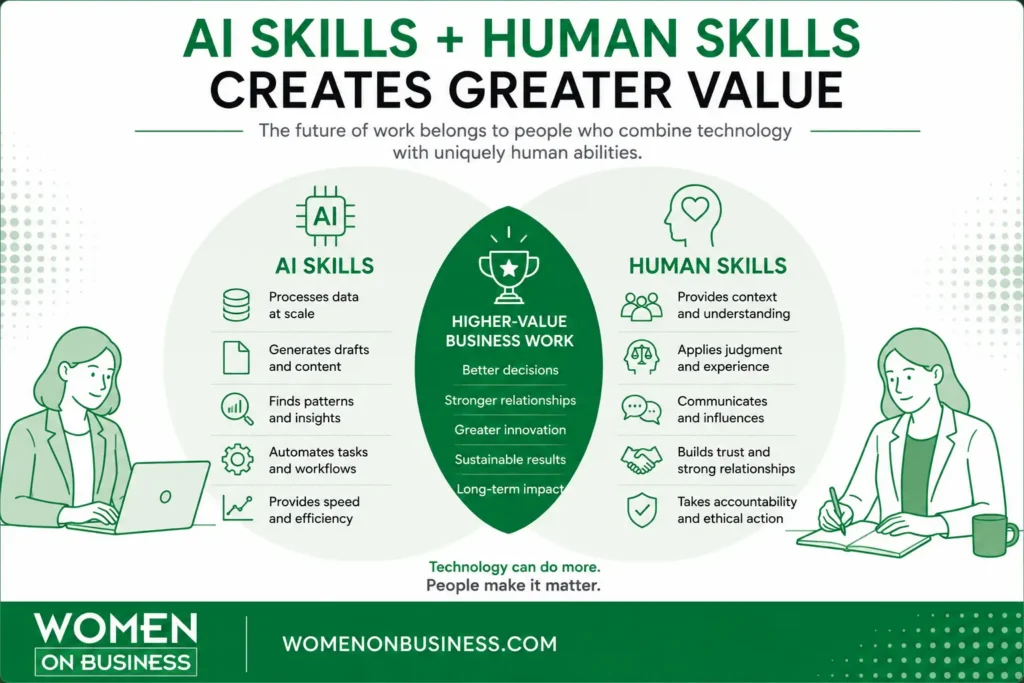
Both are necessary today. Employers need people who can use AI tools while evaluating the accuracy and implications of the results. Human skills help workers determine when AI output is useful, incomplete, inappropriate, or wrong.
How can I demonstrate these skills at work?
Choose projects that produce visible results. Lead presentations, investigate problems, improve workflows, write decision documents, train colleagues, or manage stakeholder conversations. Track the result so your contribution can be described with specific evidence.
Can these skills be learned?
Yes. Although some people may be naturally stronger in certain areas, all 10 abilities can be improved through practice, feedback, observation, and experience. The key is to work on them deliberately rather than assuming they’ll develop automatically.
Build a Career Around Work that Requires Human Judgment
The abilities identified in the Resume Now study aren’t permanently protected from technological change. AI will continue to improve at interpreting language, identifying patterns, organizing information, and producing recommendations.
However, business decisions still take place within human systems. People bring competing interests, incomplete information, emotional reactions, ethical responsibilities, and consequences that can’t always be reduced to data.
Women who learn to use AI while strengthening their communication, reasoning, focus, and judgment can position themselves for work with greater responsibility and influence.
As technology completes more routine tasks, the opportunity is to become the person who understands what the information means, recognizes what could go wrong, and helps others decide what to do next.
References
- International Labour Organization. (2026). Gen AI, Occupational Segregation and Gender Equality in the World of Work.
https://www.ilo.org/publications/gen-ai-occupational-segregation-and-gender-equality-world-work - International Labour Organization. (2025). Generative AI and Jobs: A Refined Global Index of Occupational Exposure.
https://www.ilo.org/publications/generative-ai-and-jobs-refined-global-index-occupational-exposure - O*NET Browse by Abilities. National Center for O*NET Development, U.S. Department of Labor.
https://www.O*Netonline.org/find/descriptor/browse/1.A/ - Resume Now. (2026). 10 Resume Skills AI Can’t Replace and How to Demonstrate Them.
https://www.resume-now.com/job-resources/careers/resume-of-the-future-report - World Economic Forum. (2025). The Future of Jobs Report 2025.
https://www.weforum.org/publications/the-future-of-jobs-report-2025/digest/
