Salary negotiation isn’t just about getting a higher paycheck. For women, it’s also a long-term wealth-building strategy, so it’s important to know salary negotiation tips that actually work today.
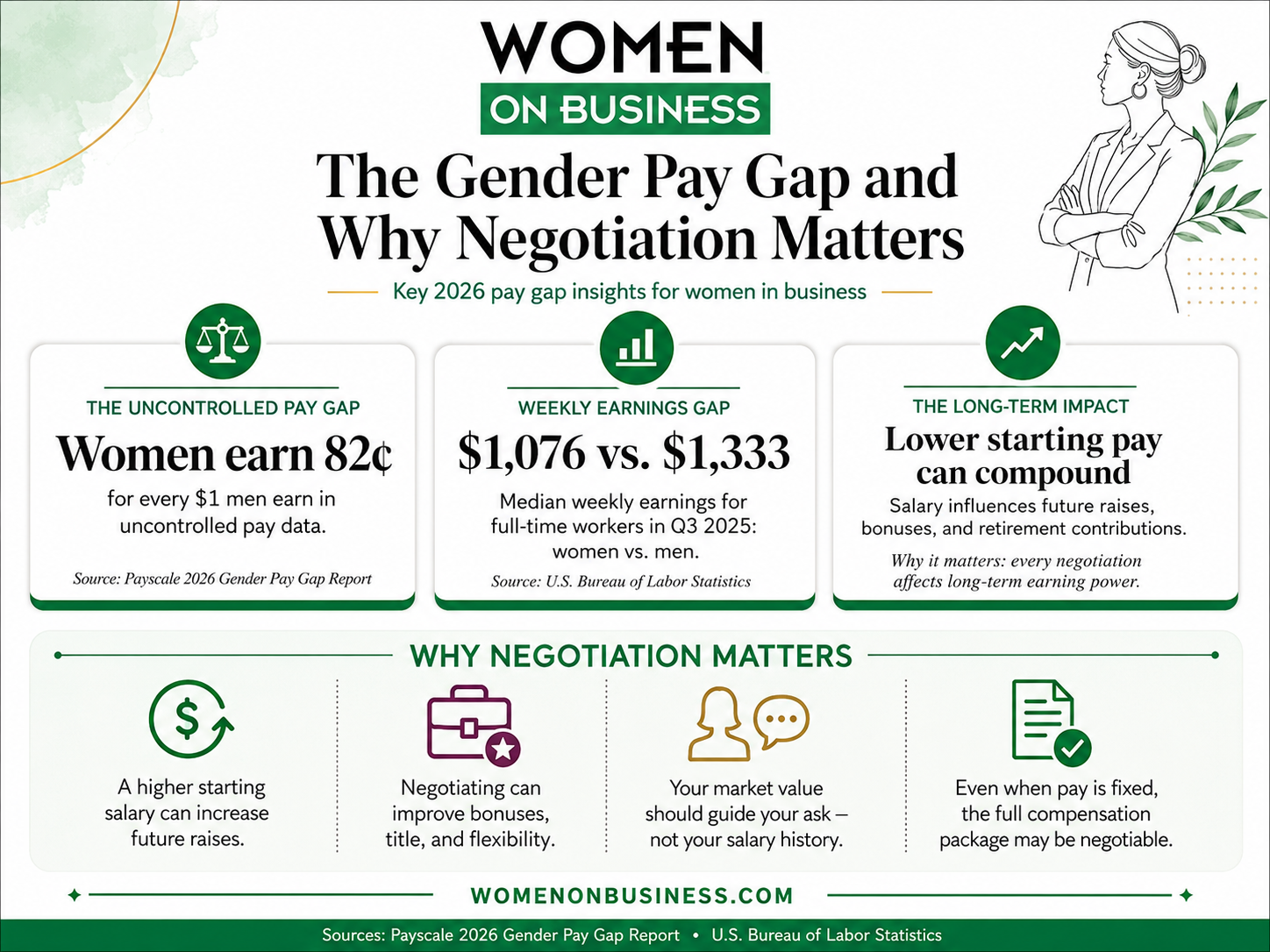
In 2026, the gender pay gap remains a serious financial issue. Payscale’s 2026 Gender Pay Gap Report found that women earn $0.82 for every $1 earned by men in uncontrolled pay data. Over a 40-year career, that gap can add up to more than $1 million in lost earnings for the average woman.
That doesn’t mean women are underpaid because they don’t negotiate. In fact, research from Harvard’s Program on Negotiation shows that women now negotiate pay as often as men in many professional settings. The bigger problem is that women often negotiate inside systems that still include biased salary histories, vague pay ranges, unequal promotion opportunities, and different reactions to assertiveness.
That’s why salary negotiation tips for women need to go beyond “just ask.” Women need practical strategies that combine market research, confident communication, timing, documentation, and a clear understanding of total compensation.
Whether you’re considering a new job offer, preparing to ask for a raise, responding to a wide salary range, or writing a salary negotiation email, the goal is the same. You have to make your compensation conversation about business value, not personal need.
Key Takeaways
- Salary negotiation is a wealth-building strategy. Even small increases can compound across future raises, bonuses, retirement contributions, and career opportunities.
- Women should research compensation before discussing salary. Use multiple sources to compare pay by role, location, industry, company size, and experience level.
- Don’t let a wide salary range anchor you too low. A posted range tells you what an employer may be willing to pay, but it doesn’t automatically define your market value.
- The strongest salary negotiations focus on future value. Your request should connect your skills, experience, and results to the business outcomes you can deliver.
- A salary negotiation email can be a powerful tool. It gives you time to organize your case, use clear language, and create a written record of your request.
Why Salary Negotiation Tips Matter for Women in 2026
The gender pay gap isn’t just a statistic. It affects retirement savings, debt repayment, homeownership, entrepreneurship, caregiving choices, and financial independence.
According to Payscale’s 2026 Gender Pay Gap Report, the uncontrolled gender pay gap widened to $0.82 for every $1 earned by men. The pay gap, which compares men and women with similar jobs and qualifications, is smaller than it has been in the past, but it still shows that pay equity hasn’t been fully reached.
The Bureau of Labor Statistics also reported that in the third quarter of 2025, women working full time had median weekly earnings of $1,076 compared with $1,333 for men. That means women’s median weekly earnings were 80.7% of men’s during that period.
Negotiation alone won’t close the gender pay gap. Employers need fair pay systems, transparent compensation practices, equitable promotion processes, and regular pay audits. However, individual negotiation still matters because every accepted salary can become the starting point for future raises, bonuses, and job offers.
That’s why women shouldn’t approach negotiation as an uncomfortable conversation to survive. They should approach it as a normal part of career management.
Step 1: Research Your Market Value Before You Discuss Salary
The most important salary negotiation work happens before the conversation begins.
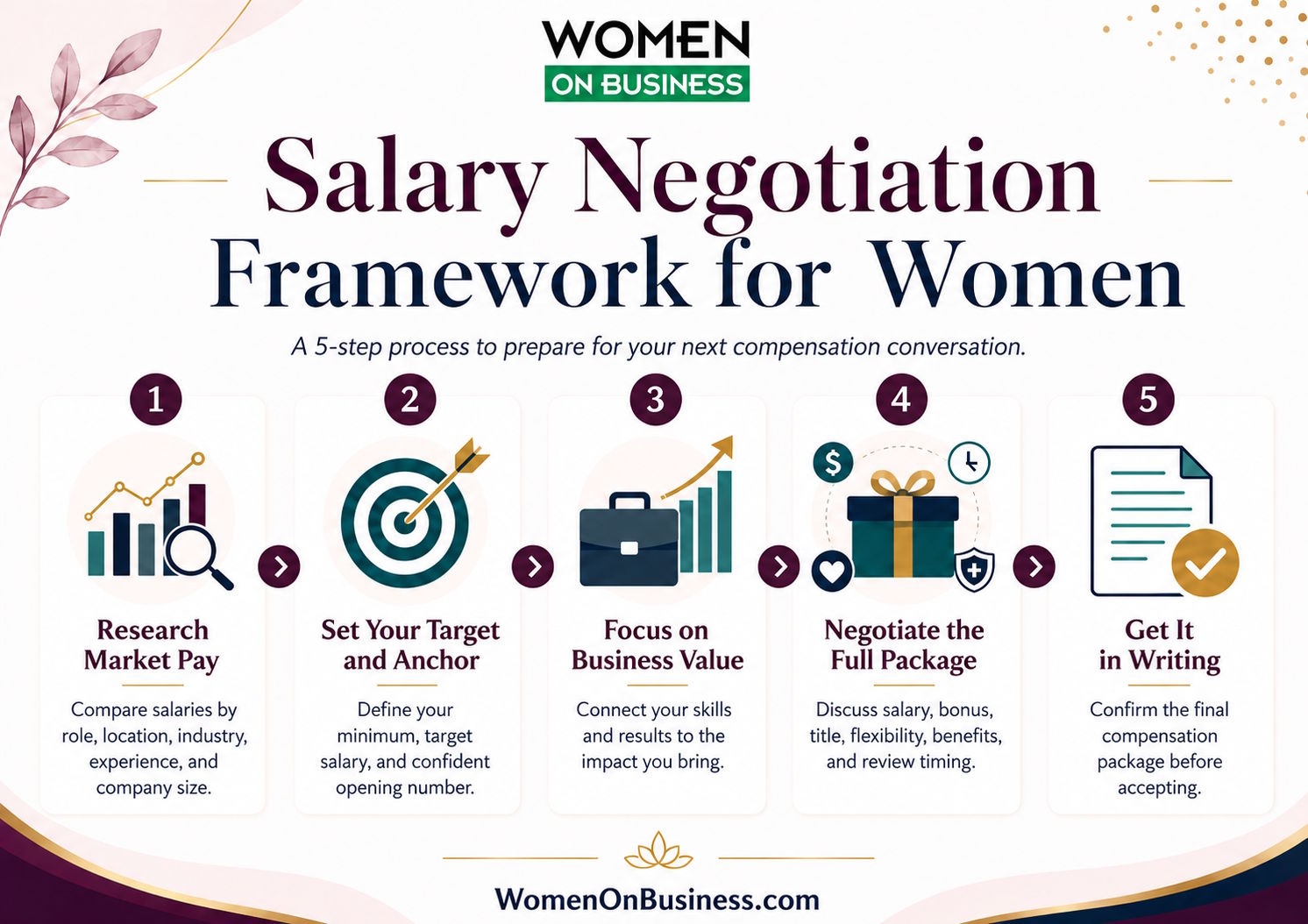
Before you share a number, apply for a promotion, or respond to an offer, gather market data from several sources. Don’t rely on one salary website because each platform uses different data, job categories, and reporting methods.
Use Sources Such As:
- Payscale.com
- Glassdoor.com
- Salary.com
- LinkedIn salary insights
- Industry association reports
- Recruiter conversations
- Job postings with salary ranges
- Trusted peers in similar roles
When You Research Salary, Compare the Role Based On:
- Job title
- Responsibilities
- Industry
- Company size
- Location
- Remote or hybrid expectations
- Years of experience
- Certifications
- Management responsibilities
- Revenue ownership
- Technical skills
- Specialized expertise.
This matters because job titles can be misleading. A “marketing manager” at one company may manage a small campaign calendar, while another may own budget, strategy, team leadership, analytics, vendors, and revenue targets. Those roles shouldn’t be paid the same simply because the title matches.
Once You Have the Data, Identify Three Numbers:
- Your minimum acceptable salary: the lowest number you’d seriously consider based on your needs and market value.
- Your target salary: the number you believe fairly reflects the role and your qualifications.
- Your anchor number: the higher number you use to begin the negotiation so there’s room to move while still landing near your target.
A good anchor is often above your target, but it should still be defensible based on the market, your experience, and the scope of the role.
Step 2: Don’t Let a Wide Salary Range Set Your Value
Pay transparency laws have made salary information more visible in many states and cities, but salary ranges aren’t always as helpful as they look.
A job posting that lists $70,000 to $130,000 gives you information, but it doesn’t tell you where you should land within that range. It may include multiple experience levels, internal leveling flexibility, geographic variation, or a range posted broadly to satisfy legal requirements.
The mistake many candidates make is treating the middle or lower end of the range as the “safe” number.
Don’t do that.
Instead, use the posted range as one piece of information, then compare it with your independent market research. If your experience, skills, and responsibilities align with the higher end of the range, prepare to make a case for the higher end.
For example, instead of saying:
“I saw the range was $70,000 to $130,000, so I’d be comfortable with $85,000.”
Say:
“Based on the scope of the role, my experience leading similar projects, and current market data, I’d be targeting compensation in the $115,000 to $125,000 range.”
That language is stronger because it doesn’t apologize, over-explain, or default to the lowest acceptable number.
Step 3: Avoid Sharing Salary History When You Don’t Have To
Your past salary isn’t the same thing as your current market value.
This is especially important for women because underpayment can compound over time. If one employer underpaid you and the next employer bases your offer on that number, the gap follows you from role to role.
Many states and cities have passed salary history bans that limit whether employers can ask about previous pay. Even when employers are allowed to ask, you don’t have to make your past compensation the center of the conversation.
If an employer asks, “What are you making now?” or “What did you make in your last role?” you can redirect the conversation.
Try this:
“I’m focused on the market value of this role and the impact I can deliver. Based on the responsibilities we’ve discussed, I’m targeting a range of $X to $Y.”
Or:
“I’d prefer to focus on the budgeted range for this position and how my experience aligns with the role.”
Or:
“My previous compensation doesn’t reflect the full scope of this opportunity, so I’d like to discuss compensation based on the responsibilities and market data for this position.”
The goal is not to be evasive. The goal is to prevent an old number from becoming the anchor for a new opportunity.
Step 4: Delay the Salary Conversation Until You Understand the Role
Timing matters in salary negotiation.
If you name a number too early, you may undersell yourself before you fully understand the role. You may learn later that the job includes managing people, owning a larger budget, building a new department, traveling frequently, or solving urgent business problems. All of those responsibilities should affect compensation.
When a recruiter or hiring manager asks for salary expectations early in the process, you can respond with curiosity and confidence.
Try this:
“I’d like to learn more about the role, team, and expectations before naming a specific number. Can you share the budgeted salary range?”
Or:
“I’m flexible depending on the total compensation package and scope of the role. What range has been approved for this position?”
Or:
“I want to make sure we’re aligned. Based on what you know so far, what compensation range is the company targeting?”
These responses are professional and strategic. They keep the conversation moving without forcing you to lock yourself into a number too soon.
Step 5: Build a Business Case, Not a Personal Plea
One of the most effective salary negotiation tips for women is to frame the conversation around business value.
Avoid making your case around personal expenses, inflation, fairness alone, or how long it has been since your last raise. Those points may be valid, but they’re usually not the strongest argument from an employer’s perspective.
Instead, connect your request to outcomes.
For a new job offer, focus on the value you’ll bring:
Revenue growth, cost savings, client retention, team leadership, operational improvements, technical expertise, strategic planning, project execution, risk reduction, brand visibility, or customer satisfaction.
For an internal raise, focus on results you’ve already delivered:
Projects completed, goals exceeded, revenue influenced, processes improved, people trained, systems created, customers retained, budgets managed, or responsibilities added.
For example, instead of saying:
“I’ve been here for three years and I think I deserve more.”
Say:
“Over the past year, I’ve taken on responsibility for X, improved Y, and contributed to Z. Based on that expanded scope and current market data for similar roles, I’d like to discuss adjusting my salary to $X.”
That’s a business case. It gives your manager something specific to evaluate and advocate for.
Step 6: Use Clear, Confident Language
Many women are taught to soften their communication to avoid seeming demanding. However, too much softening can weaken a negotiation.
You don’t need to be aggressive. You do need to be clear.
Avoid phrases like:
- “I was just wondering…”
- “I know budgets are tight…”
- “I’m sorry to ask…”
- “I don’t know if this is possible…”
- “I’d be happy with anything close to…”
Use language like:
- “Based on my research…”
- “Given the scope of the role…”
- “I’m targeting…”
- “My expectation is…”
- “I’d like to discuss…”
- “A salary of $X would better reflect…”
Confidence doesn’t mean refusing to collaborate. It means you’re not negotiating against yourself before the employer even responds.

Step 7: Be Ready for Silence and Pushback
Silence is common in negotiation. Don’t rush to fill it by lowering your number.
If you state your salary expectation and the other person pauses, let the pause happen. A few seconds of silence can feel uncomfortable, but it doesn’t mean you said something wrong.
If you receive pushback, ask questions.
If they say, “That’s above our range,” ask:
“Can you share more about the approved range for this role?”
If they say, “We don’t have flexibility,” ask:
“Is the base salary fixed, or is there flexibility in bonus, title, review timing, or other parts of the package?”
If they say, “We’ll revisit this later,” ask:
“Can we define a specific review timeline and the performance criteria that would support an adjustment?”
Pushback is not the end of the negotiation. It’s the point where you learn what else may be possible.
Step 8: Negotiate the Full Compensation Package
Base salary matters because it affects future raises, retirement contributions, bonuses, and long-term earnings. However, it’s not the only part of compensation.
If the employer can’t meet your salary request, consider negotiating:
Signing bonus, annual bonus, equity or stock options, title, promotion timeline, remote or hybrid schedule, paid time off, professional development budget, certification reimbursement, conference attendance, relocation support, childcare support, wellness benefits, severance terms, or a six-month salary review.
Here’s a useful response:
“If the base salary can’t move, I’d like to discuss other ways to make the total package more competitive.”
You can also say:
“Would it be possible to include a signing bonus and schedule a compensation review after six months based on agreed-upon performance goals?”
This approach keeps the conversation open and shows that you’re focused on a workable agreement.
Step 9: Put Your Salary Request in Writing
A salary negotiation email can be especially useful because it gives you time to organize your thoughts and present your case clearly.
Use a simple structure:
- Thank them for the offer or conversation.
- Express enthusiasm for the role or continued work.
- State your salary request clearly.
- Support the request with market data, role scope, and value.
- Invite continued conversation.
Here’s a sample salary negotiation email for a new job offer:
Subject: Compensation Discussion
Thank you again for the offer. I’m excited about the opportunity to join the team and contribute to [specific goal, project, or business area].
After reviewing the scope of the role and current market data for similar positions, I’d like to discuss a starting salary of $X. Given my experience with [specific skill or result] and the impact I believe I can make in the role, this number better reflects the value I’d bring to the organization.
I’m very interested in the opportunity and would be happy to discuss a compensation package that works well for both of us.
Thank you again,
[Your Name]
Here’s a sample salary negotiation email for an internal raise:
Subject: Compensation Review Request
Hi [Manager Name],
I’d like to schedule time to discuss my compensation and how it aligns with my current responsibilities and contributions.
Over the past [time period], I’ve [specific accomplishment], [specific accomplishment], and [specific accomplishment]. My role has also expanded to include [new responsibility or scope]. Based on these contributions and current market data for similar roles, I’d like to discuss adjusting my salary to $X.
I appreciate the opportunity to continue growing here and would welcome a conversation about how my compensation can better reflect the impact I’m delivering.
Thank you,
[Your Name]
Keep the message professional, concise, and specific. The goal is to make it easy for the recipient to understand your request and, if needed, share the business case with HR or leadership.
Step 10: Always Ask for the Final Offer in Writing
Before accepting a job offer or compensation change, get the details in writing.
That includes:
Base salary, bonus terms, title, start date, reporting structure, remote or hybrid schedule, paid time off, benefits, equity, signing bonus, review timeline, and any other negotiated terms.
A verbal agreement is encouraging, but a written agreement protects everyone from confusion later.
You can say:
“Thank you. I’m excited to move forward. Could you please send the updated offer details in writing so I can review everything together?”
That’s a normal, professional request.
Frequently Asked Questions about Salary Negotiation Tips
What are the best salary negotiation tips for women in 2026?
The best salary negotiation tips for women in 2026 are to research market pay before discussing salary, avoid relying on past compensation, anchor your request based on the role’s value, focus on measurable business impact, and negotiate the full compensation package rather than base salary alone.
How do I negotiate salary when a job posting has a wide salary range?
Treat the posted range as helpful context, not as your personal value. Research comparable roles, assess where your experience fits within the range, and make a specific request based on the scope of the job and your qualifications. Don’t automatically aim for the lower or middle of the range.
How do I ask for a raise without sounding demanding?
Use a business-focused approach. Document your results, show how your responsibilities have expanded, compare your compensation with market data, and request a specific adjustment. A raise conversation should be framed around contribution and alignment, not apology or personal need.
Is it better to negotiate salary by email or in person?
Both can work. A live conversation can build rapport, while email gives you more control over structure and wording. Many people use both. They discuss compensation verbally, then follow up with a written summary of the request.
Can salary negotiation help close the gender pay gap?
Salary negotiation alone won’t close the gender pay gap because the gap is shaped by workplace systems, promotion patterns, caregiving penalties, occupational segregation, and bias. However, negotiation can still help individual women protect their earning power and avoid compounding underpayment across future roles.
Conclusion: Don’t Just Ask — Anchor Your Value
The most important salary negotiation shift for women in 2026 is moving from asking for approval to anchoring market value. Enter the conversation with data, a clear number, documented impact, and the confidence to pause instead of immediately lowering your request.
Negotiation is a skill, and it gets easier with practice. The first conversation may feel uncomfortable. The next one will feel more familiar. Over time, you’ll learn how to respond to pushback, evaluate offers, and recognize when an employer is willing to invest fairly in your work.
Women shouldn’t have to negotiate their way around unfair systems. Employers are responsible for building equitable compensation practices. But until every workplace gets there, knowing how to negotiate a salary can help women protect their income, strengthen their financial futures, and make more informed career decisions.
Don’t let someone else’s range become your ceiling. Know your value, support it with evidence, and negotiate from there.
References and Resources
- World Economic Forum Global Gender Gap Report 2024
- SHRM Pay Equity Resources
- U.S. Census Bureau, Equal Pay Day 2026
- Harvard Program on Negotiation, Negotiating a Salary When Compensation Is Public
- National Women’s Law Center, The Lifetime Wage Gap, State by State
- National Women’s Law Center, The Wage Gap, State by State
- Pew Research Center, Gender Pay Gap in U.S. Has Narrowed Slightly Over 2 Decades
- SHRM, Pay Equity Gets More Attention, but Gaps Still Remain
- SHRM, Managing Pay Equity: A Strategic Toolkit for HR Professionals