Despite decades of progress, gender pay gap statistics in 2026 show equal pay remains one of the most persistent financial challenges facing women in business today. While headlines often focus on the well-known “cents on the dollar” comparison, recent research shows the wage gap begins much earlier — at the level of salary expectations and job application behavior.
Data from JobLeads, based on nearly one million platform users, reveals that women aren’t just paid less — they often aim lower before offers are even made.
Understanding these gender pay gap statistics is critical for women who want to increase their earning power, negotiate effectively, and build long-term wealth.
Below, we break down the most compelling data from the JobLeads research and what it means for women professionals, entrepreneurs, and leaders.
Gender Pay Gap Statistics: The Most Important Data Points
Here are the key findings women in business should know:
- Women earn approximately 83 cents for every dollar earned by men in the United States.
- Women’s salary expectations are 9.5% lower than men’s, even before applying for jobs.
- Women apply to roles with a median salary about $12,667 lower than the median salary of roles men apply for.
- At higher salary bands, women’s expectations remain about 8% lower than men’s.
- Women with bachelor’s degrees earn roughly 80% of men’s earnings early in their careers.
- Women are more likely to seek part-time or flexible roles, which typically correlate with lower compensation.
Each of these factors compounds over time and affects promotions, retirement savings, and lifetime wealth accumulation.
Why the Gender Pay Gap Starts Before Negotiation
When discussing salary negotiation for women, many assume the problem begins at the offer stage. However, data suggests it starts much earlier.
1. Lower Salary Expectations
Before submitting applications, women report lower expected salaries than men — by nearly 10% on average.
This expectation gap matters because:
- Employers often anchor offers around candidate expectations.
- Lower expectations reduce negotiating leverage.
- Women may eliminate themselves from higher-paying opportunities before applying.
Over a 30-year career, even a modest 8–10% salary difference can translate into hundreds of thousands of dollars in lost earnings, and that doesn’t even include investment growth.
2. Women Apply to Lower-Paying Jobs
Research shows that while men and women browse job listings at similar rates, women apply to positions with significantly lower median salaries — about $12,667 less.
This behavioral gap may be influenced by:
- Confidence differences
- Risk aversion
- Perceived qualification gaps
- Workplace culture concerns
For women in business, this highlights a powerful strategy. You should intentionally expand your salary targets and apply for stretch roles.
Industry Segregation and High-Paying Fields
Occupational segregation continues to influence wage disparities. Women are heavily represented in industries such as:
- Healthcare
- Education
- Administrative services
These fields are essential, but they often pay less than male-dominated industries like:
- Technology
- Engineering
- Finance
Even within the same industry, pay differences persist. In professional services and legal fields, for example, men may still out-earn women by more than 20%.
For women seeking to maximize earning potential, industry selection, specialization, and advancement pathways play a major role.
The “Flexibility Tax” and Caregiving Impact
Another contributor to the gender wage gap is flexibility.
Women are significantly more likely to pursue:
- Part-time roles
- Hybrid positions
- Flexible scheduling
While flexibility can improve work-life integration, it may also:
- Reduce eligibility for promotions
- Limit access to leadership tracks
- Lower annual compensation
- Decrease retirement contributions
Over time, this creates what many economists call a “flexibility tax.”
For business owners and corporate leaders, this presents an opportunity to design flexible workplaces that don’t penalize career growth. Doing so could turn into a powerful competitive advantage.
The Long-Term Impact of the Wage Gap
The gender pay gap doesn’t just affect today’s paycheck. It impacts:
- Lifetime earnings
- Investment growth
- Social Security benefits
- Retirement savings
- Entrepreneurial capital accumulation
A consistent 15–20% income gap across decades can result in dramatically lower net worth at retirement age.
At the current pace of progress, projections suggest full pay parity could still be decades away — potentially into the 2080s.
What Women in Business Can Do Now
While systemic change is necessary, individual strategy also matters.
1. Raise Salary Anchors
Research compensation data before interviews and set ambitious but realistic targets.
2. Apply Up, Not Sideways
If you meet most but not all qualifications, apply anyway.
3. Negotiate Every Offer
Even small percentage increases compound significantly over time, so be prepared to negotiate.
4. Seek High-Growth Industries
Strategically positioning yourself in expanding, high-margin sectors can accelerate earnings.
5. Advocate for Pay Transparency
Organizations with transparent compensation structures often show smaller pay gaps.
Gender Pay Gap Statistics 2026: The Bottom Line
As the gender pay gap statistics show, the problem isn’t simply about unequal pay for equal work. It’s shaped by:
- Salary expectations
- Application behavior
- Industry selection
- Caregiving dynamics
- Workplace culture
- Negotiation patterns
For women in business, awareness is leverage. Understanding the data allows you to:
- Make informed career decisions
- Increase your negotiation confidence
- Mentor other women strategically
- Advocate for systemic improvements
While progress continues, meaningful pay equity will require both personal action and structural change.
The most powerful takeaway? Aim higher. Apply higher. Negotiate higher.
Because long-term financial independence, business success, and generational wealth start with closing the gap — one strategic move at a time.
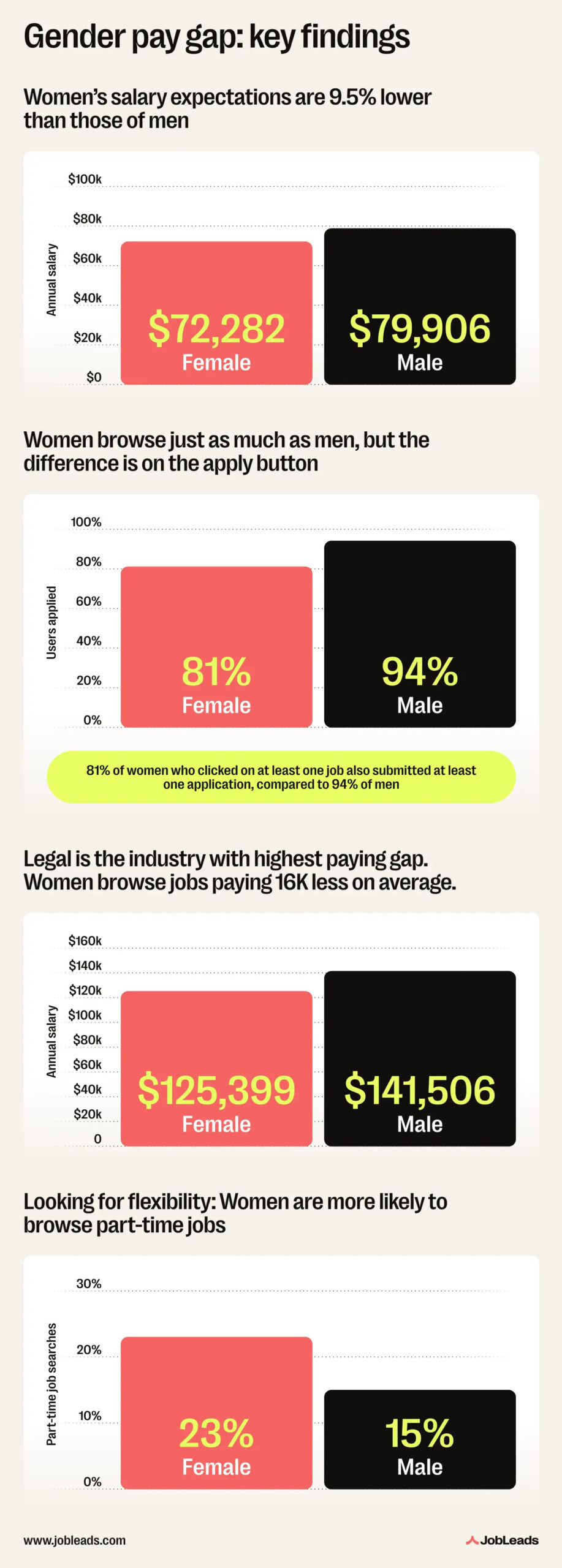
Gender Pay Gap Statistics via JobLeads
