
You can do excellent work, meet every deadline, and still watch someone else receive the promotion you thought you had wrapped up.
It’s frustrating, and it can leave you wondering whether your work is valued at all.
Performance matters, but career advancement usually depends on more than performance. Managers and senior leaders also consider your visibility, relationships, leadership potential, business judgment, and readiness to handle broader responsibilities.
But that’s not all. Women face even more barriers. The 2025 Women in the Workplace report from McKinsey & Company and LeanIn.Org found that the first step into management has a big gender gap. For every 100 men promoted to manager, only 93 women received the same promotion.
That doesn’t mean women are responsible for fixing workplace inequality. Employers need fair promotion practices, transparent career paths, and leaders who support qualified employees equitably.
Still, you can take steps to make your goals clearer, build stronger support, and create more career options. The following career advancement strategies can help you move ahead without pretending that hard work alone controls every outcome.
Key Takeaways
- Strong performance is essential, but decision-makers also need to understand your impact, potential, and career goals.
- Don’t wait until a promotion opens to discuss advancement with your manager.
- Track business results so you can explain your contributions with evidence.
- Look for mentors who advise you and sponsors who advocate for you.
- Build relationships across departments, levels, and organizations.
- Choose development opportunities that prepare you for a specific next step.
- Evaluate whether your employer offers a realistic path forward.
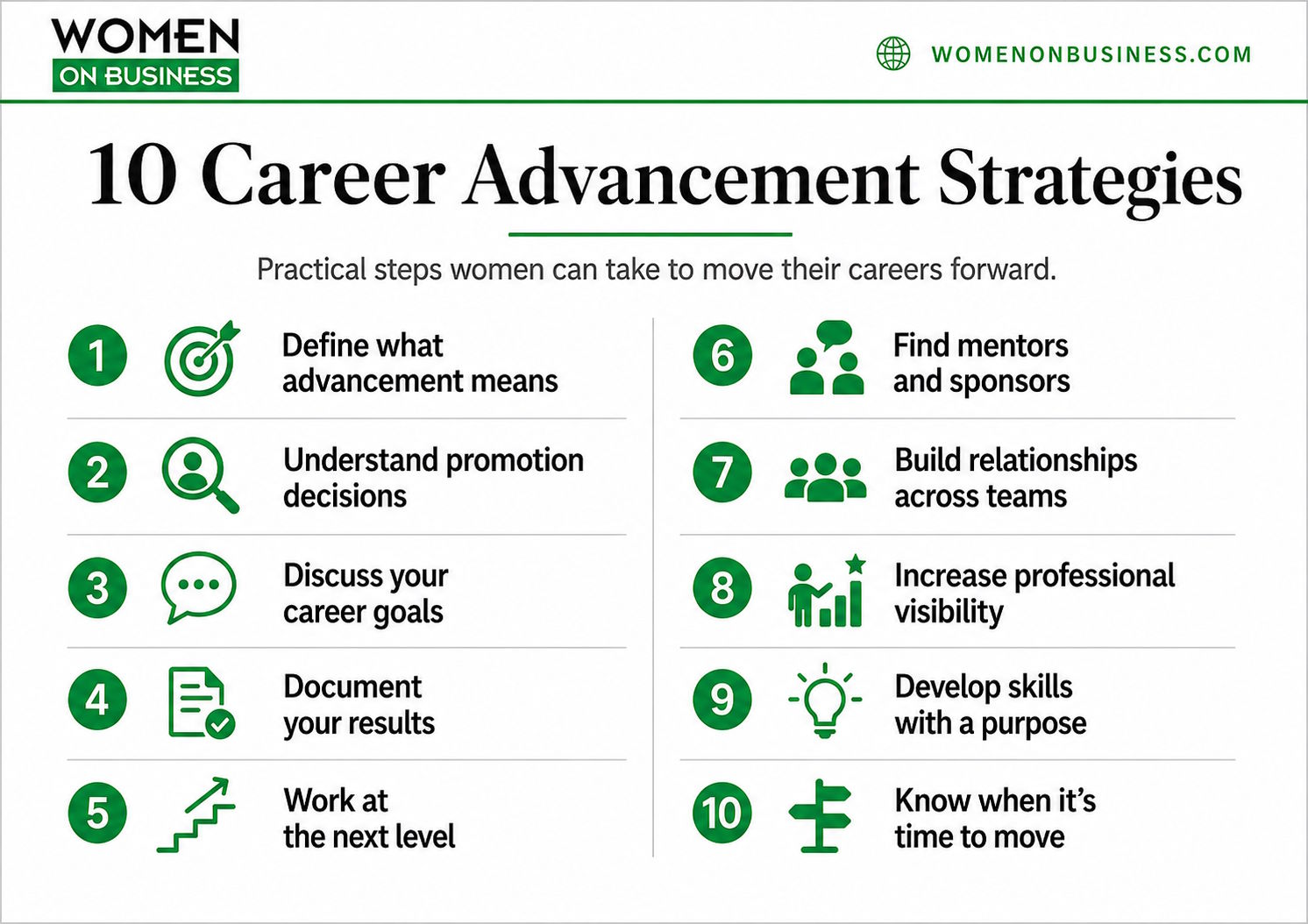
1. Decide What Career Advancement Means to You
Career advancement doesn’t always mean becoming a senior executive. You might want to manage people, lead larger projects, become a respected specialist, earn more money, enter a different department, or move to an employer with better opportunities.
Start by identifying the kind of work you want to do next.
Imagine you’re a marketing manager who enjoys planning campaigns but doesn’t like supervising employees. The typical next step might be a marketing director position, but that job could involve less campaign work and much more hiring, budgeting, and personnel management. In that case, a senior strategy or specialist role might suit you better.
Ask yourself:
- What responsibilities do I want to do more?
- Which responsibilities do I want to do less?
- Do I want to manage people, projects, budgets, strategy, or a combination?
- What would make a new position feel like genuine progress?
- What tradeoffs am I willing to accept?
A clear goal for your career path makes it easier to choose the right opportunities instead of pursuing every title that looks impressive.
2. Learn How Advancement Decisions Are Made
Every workplace has written rules and unwritten expectations. The employee handbook might explain when performance reviews happen, but it probably won’t tell you who influences promotion decisions, which experiences senior leaders value, or whether promotions depend solely on available headcount.
Ask your manager what the next level requires. Request specific information from them rather than general encouragement.
For example, you could say:
“I’d like to work toward a senior manager position. What results, skills, and experiences would I need to demonstrate to be considered ready?”
The answer may reveal that you need budgeting experience, stronger presentation skills, responsibility for a larger client, or exposure to another part of the business. Try to get the information in writing, so when the time comes to ask for a promotion, you have the proof that you met the requirements you were given.
Also ask how promotions are approved and when planning decisions occur. In many companies, promotion discussions begin months before employees hear about them. Asking one week before your annual review may be too late.
3. Discuss Your Career Goals Directly
Your manager may not know you want a promotion. Some employees make their ambitions very clear. They ask about advancement, volunteer for relevant assignments, and remind leaders of the roles they’re working toward. Other employees assume their work will speak for itself.
Your work does speak, but it doesn’t always explain what you want it to, and the right people may not notice or connect the dots.
Tell your manager where you’d like to go in your career and ask for help creating a realistic plan. Discuss the subject regularly rather than mentioning it once during an annual review.
For example:
“Over the next year, I’d like to prepare for a director-level role. Could we identify two or three areas I should strengthen and review my progress every few months?”
This approach turns your one-time conversation into an ongoing discussion with deliverables and milestones.
4. Document Your Results
A long list of completed tasks isn’t the same as proof that those tasks had an impact on the business.
Keep a private file that documents what you accomplished, why it mattered, and any evidence of the result. Update it throughout the year while the details are still fresh.
Include outcomes such as:
- Revenue generated or protected
- Costs reduced
- Time saved
- Processes improved
- Risks prevented
- Customer satisfaction gains
- Employee retention or development
- Successful projects
- Problems resolved
- Positive client or leadership feedback
Consider the difference between the following two statements:
- “I managed the customer onboarding project.”
- “I led a customer onboarding redesign that reduced the average implementation time from six weeks to four.”
The second statement helps a decision-maker understand the business value of your work, and shows that you understand how employees can impact the business’ strategic goals.
Not every contribution can be quantified, but you should still describe the scope, challenge, and result clearly.
5. Show That You Can Work at the Next Level
One of the best career growth strategies is to show that you can do the next role before you get the title. Before you freak out, this doesn’t mean doing an entire higher-level job indefinitely without appropriate pay. It means finding reasonable opportunities to show that you’re capable of more or different responsibility.
You might lead a cross-departmental project, present recommendations to senior leaders, train a new employee, manage a vendor relationship, or help solve a recurring business problem.
For instance, a financial analyst might be known for producing accurate monthly reports. That makes her a strong analyst, but to be considered for management, she needs to demonstrate that she can explain financial patterns, recommend actions, and help nonfinancial colleagues make better decisions. Accuracy established her credibility. Strategic business judgment strengthens her case for advancement.
Look for assignments that fill a specific gap in your experience, offer visibility, or provide the quantifiable evidence you need to show you’re ready for career advancement.
6. Find Mentors and Sponsors
Mentors and sponsors can both contribute to your career, but they serve different purposes.
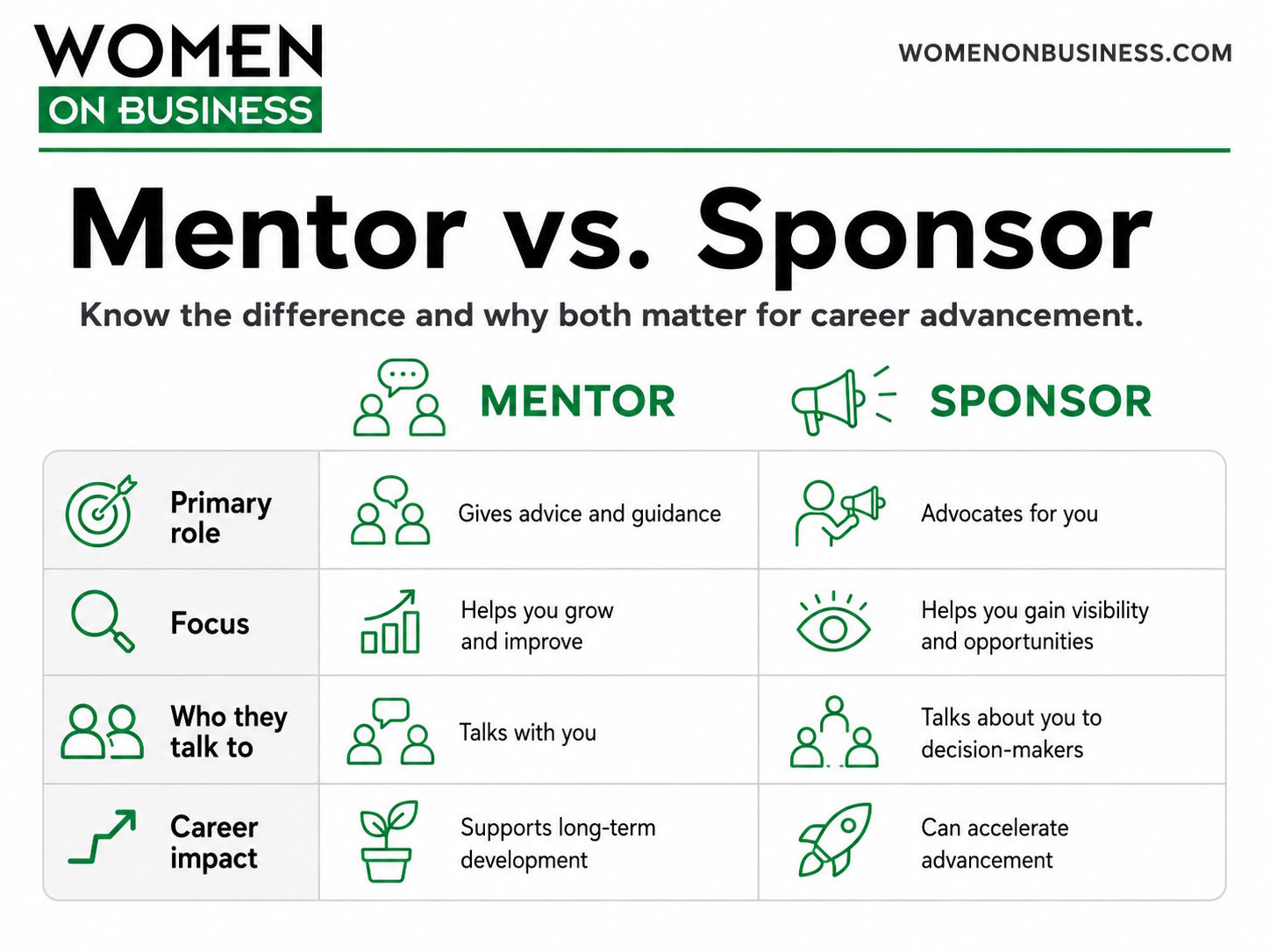
A mentor helps you think through decisions, improve your skills, and learn from experience. A sponsor advocates for you with other decision-makers and may recommend you for a promotion, leadership assignment, or important introduction.
Sponsorship usually develops after a leader has seen your judgment, reliability, and results. You need to build credibility by doing strong work, contributing to visible initiatives, and keeping influential people appropriately informed about your progress.
After you’ve been noticed by a leader or you’ve built a relationship with them, you can ask them to support you in your career advancement efforts (or they may offer to help you).
You can also ask your manager or mentor for introductions to leaders whose work relates to your goals.
Remember that mentors and sponsors are often two (or more) different people. You might have a former supervisor who gives honest advice, a senior leader who advocates for you, and a peer who shares useful information about opportunities.
7. Build Relationships Beyond Your Immediate Team
A network shouldn’t be made up entirely of people who do the same work as you.
Relationships across departments can be just as important because they help you understand how the business operates, learn about upcoming initiatives, and become known outside your regular circle.
To make connections outside of your team, start with normal professional interaction. Invite a colleague from another department to have coffee. Ask someone to explain how her team measures success. Offer useful information, make an introduction, or share credit when another person contributes to a successful project.
Networking becomes uncomfortable when every conversation feels like a request. It becomes much more natural when it’s based on curiosity, reciprocity, and consistent contact.
External relationships matter, too. Professional associations, former colleagues, industry events, online communities, and volunteer leadership roles can all expand your options.
8. Increase Your Professional Visibility
Visibility means making sure the right people understand what you contribute. You just have to be careful not to take credit from colleagues or turn every conversation into self-promotion.
To increase visibility, provide concise updates on important projects, and share credit while being clear about your own role. When the opportunity comes up, volunteer to represent your department at meetings or events, and contribute useful ideas during meetings.
External visibility can also support career advancement for women. Depending on your profession, you could speak at an industry event, contribute an article to a professional publication, participate in an industry panel, teach a workshop, or share your professional insights online.
The key is to choose activities that reinforce expertise you actually have. Publishing frequent opinions about every trending topic won’t necessarily help your reputation.
Useful visibility is relevant, credible, and connected to your career direction.
9. Build Skills with a Purpose
Taking courses can feel productive, but more credentials don’t automatically lead to better opportunities. Before investing time or money, determine which skills will help you qualify for the role you want.
Review job descriptions for positions one or two levels above yours. Look for recurring requirements. Ask people in those roles which abilities matter most in practice.
You may discover that you don’t need another broad leadership program. You might need experience managing a budget, using a particular system, negotiating contracts, analyzing data, or delivering presentations to executives.
Technology skills will continue to matter in many business functions, including the ability to use artificial intelligence tools responsibly. Human skills like judgment, communication, conflict management, and coaching will matter, too.
The best development plan combines learning with application. A course introduces a skill. A real assignment proves you can use that skill.
10. Know When Career Advancement Requires a Move
Sometimes the problem isn’t your strategy. The opportunity just doesn’t exist where you work.
Perhaps the next role is occupied by someone who has no plans to leave. Maybe your company routinely hires managers from outside. You may be performing higher-level work without recognition, or your manager may repeatedly change the requirements for promotion.
Look for patterns rather than relying on promises. A delayed promotion can have a reasonable explanation, but several years of vague assurances, shifting expectations, and no concrete progress tell a different story.
Before leaving, ask direct questions:
- Is a higher-level role likely to become available?
- What specific requirements haven’t I met?
- Who makes the final decision?
- What timeline is realistic?
- What evidence would demonstrate my readiness?
Compare the answers with what actually happens. The results will tell you what to do.
Changing employers isn’t always necessary, but staying indefinitely in a position with no path forward can limit your earnings, experience, and confidence. In a world where women already earn less than men for the same jobs, which negatively affects their earnings today and their retirement income, you need to know when it’s time to leave. Maintaining an external network gives you choices before frustration reaches a breaking point.
Create a 90-Day Career Advancement Plan
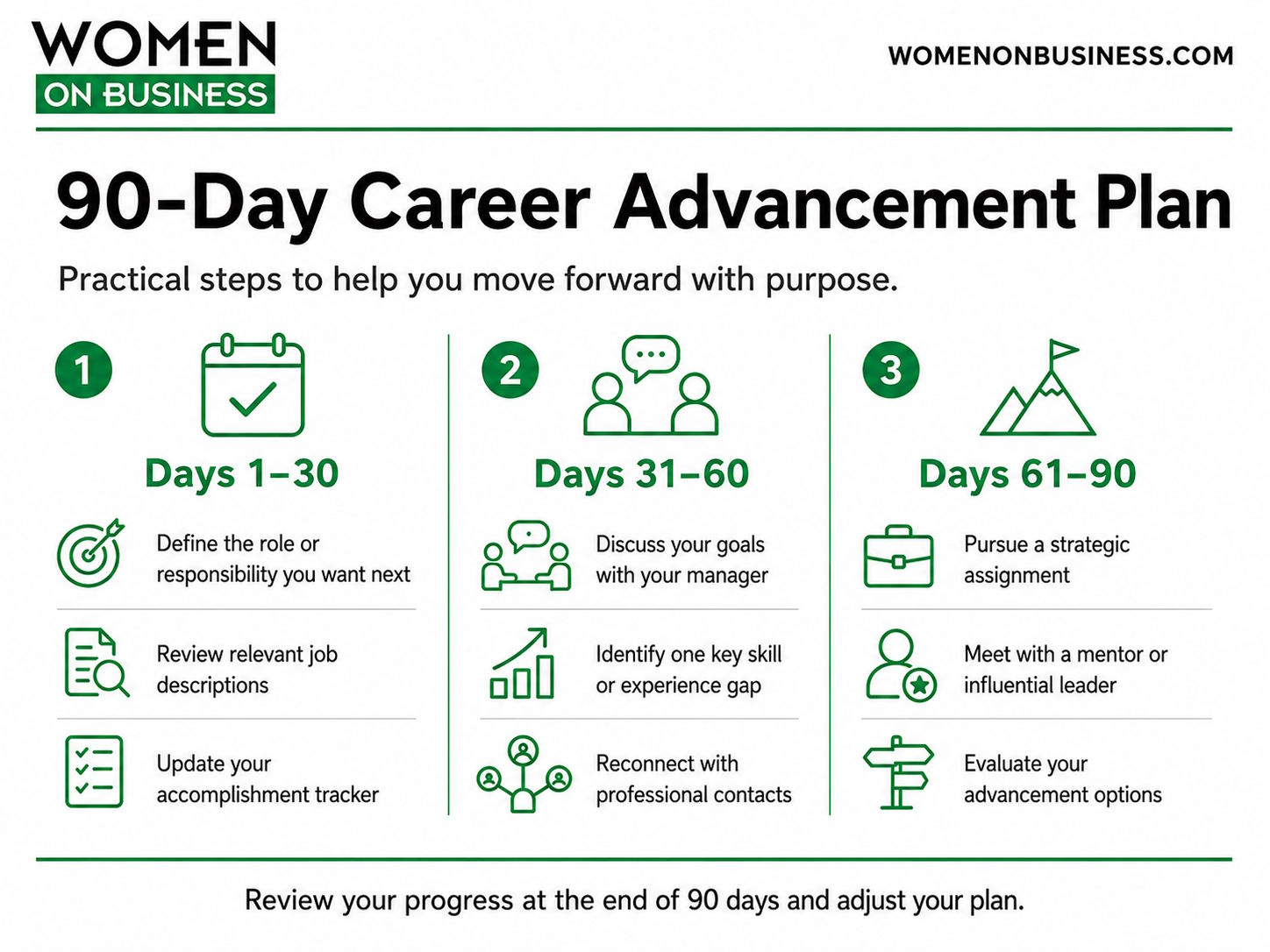
You don’t need to address every strategy at once. Choose a few actions you can complete over the next 90 days. For example:
During the First 30 Days:
- Define the role or responsibility you want next.
- Review several relevant job descriptions.
- Update your record of accomplishments, your resume, and your LinkedIn Profile.
During Days 31 Through 60:
- Discuss your goals with your manager.
- Identify one experience or skill gap.
- Reconnect with two professional contacts.
During Days 61 Through 90:
- Pursue an assignment that builds the missing experience.
- Meet with a potential mentor or influential leader.
- Review whether your employer’s advancement path is credible.
At the end of 90 days, evaluate what changed. Did you gain useful information? Did your manager follow through? Are you receiving better assignments or greater exposure?
Frequently Asked Questions About Career Advancement Strategies
What are career advancement strategies?
Career advancement strategies are deliberate actions that help you qualify for and gain better professional opportunities. They can include skill development, performance tracking, networking, sponsorship, leadership experience, increased visibility, and direct conversations about promotion.
How can I advance my career when there are no promotion opportunities?
Look for ways to expand your responsibilities, lead important projects, learn transferable skills, and build relationships outside your department. At the same time, investigate opportunities with other employers. Career advancement may require an internal transfer or external move rather than a promotion within your existing department.
How do I tell my manager I want to advance?
Be direct and specific. Explain the role or type of responsibility you’re targeting, ask what readiness looks like, and request measurable development steps. Revisit the conversation throughout the year instead of waiting for your annual review.
What is the difference between a mentor and a sponsor?
A mentor advises you and helps you develop. A sponsor advocates for you with people who control assignments, promotions, and other opportunities. Many women benefit from having both.
How often should I review my career development plan?
Review it at least once every three months. Check your progress, update your goals, note new opportunities, and decide whether your current actions are moving you toward the work you want.
Conclusion: Career Advancement Requires More Than Hard Work
Hard work is part of career advancement, but it isn’t the only part.
People need to know what you’ve accomplished, what you want, and why you’re ready for greater responsibility. You also need honest feedback, relevant experience, strong professional relationships, and an employer that provides a genuine path forward.
Some of these factors are within your control. Others aren’t.
Start with one conversation or one action. Tell your manager where you want to go. Document a result you’ve never properly explained. Contact someone whose career you respect.
Small, deliberate actions can reveal whether you’re moving forward in your current company or if it’s time to find a place where you can.