
Becoming a manager can change your title, responsibilities, and place on the organizational chart. Becoming a leader changes how people experience working with you. The two roles often overlap, which is why discussions about the characteristics of a manager and a leader can become confusing.
Managers organize work, coordinate resources, monitor performance, and make sure commitments are met. Leaders help people understand where they’re going, why the work matters, and how they can contribute.
Strong organizations need both capabilities. A compelling vision won’t accomplish much without planning and follow-through. An efficient operation can also lose momentum when employees don’t feel trusted, supported, or connected to a meaningful purpose.
You don’t need a senior title or a large team to begin demonstrating leadership. You can earn trust, influence decisions, improve collaboration, and help colleagues navigate uncertainty from almost any position.
Understanding the characteristics of a manager and a leader can help you identify the skills you already possess and the ones you should develop next.
Key Takeaways
- Managers coordinate people, priorities, resources, and processes so work gets completed effectively.
- Leaders create direction, build trust, influence decisions, and help people perform at their best.
- Management authority usually comes with a role, while leadership influence can be developed at any career level.
- Strong professionals combine operational discipline with communication, judgment, empathy, accountability, and adaptability.
- Leadership improves through deliberate practice, useful feedback, reflection, and experience applying new behaviors.
What is the Difference Between a Manager and a Leader?
A manager is responsible for organizing work and delivering results through other people. A leader influences people toward a shared goal.
Those definitions describe different areas of emphasis rather than two entirely separate types of professionals. Many people must manage and lead at the same time.
A department head may create a project schedule, assign responsibilities, monitor the budget, and review performance. Those are management responsibilities. That same person may also explain why the project matters, invite the team to challenge assumptions, protect employees from unnecessary distractions, and help people remain focused during a setback. Those are leadership behaviors.
The most effective professionals know when each capability is needed.
What is a Manager?
A manager holds formal responsibility for a function, project, process, or group of employees. Her work typically includes setting expectations, assigning tasks, managing resources, evaluating performance, resolving operational problems, and reporting results.
Good management gives a team structure. Employees need to know what success looks like, which priorities matter most, when work is due, and who has the authority to make decisions.
Gallup has repeatedly reported that managers account for a significant share of the variation in team engagement. That finding demonstrates how much a manager’s daily behavior can shape the employee experience. Clear expectations, meaningful feedback, recognition, and development conversations affect how employees approach their work.
Imagine that a marketing team is preparing for a product launch. The manager creates the timeline, confirms the budget, assigns campaign responsibilities, coordinates with sales, and tracks whether each deliverable is ready. Without that work, even a talented team could miss important deadlines or duplicate its efforts.
Management becomes ineffective when administration replaces judgment. A manager who concentrates only on task completion may overlook employee concerns, changing business conditions, or opportunities to improve the original plan.
What is a Leader?
A leader helps people move toward a worthwhile objective. She creates clarity, earns confidence, makes difficult decisions, and encourages others to contribute their knowledge.
Leadership can come with formal authority, but a title isn’t required.
An experienced analyst may lead by identifying a risk that others missed and helping the group respond. A new employee may improve a cumbersome process and persuade several departments to adopt the change. A business owner may lead by establishing standards that guide decisions even when she isn’t present.
The Center for Creative Leadership describes leadership as a social process that produces direction, alignment, and commitment. This perspective moves leadership away from the idea of a commanding individual who always has the answers. Leadership happens through relationships and shared work.
Leadership is especially visible when circumstances are unclear. People look to leaders for an honest interpretation of what’s happening, a credible path forward, and reassurance that important concerns won’t be ignored.
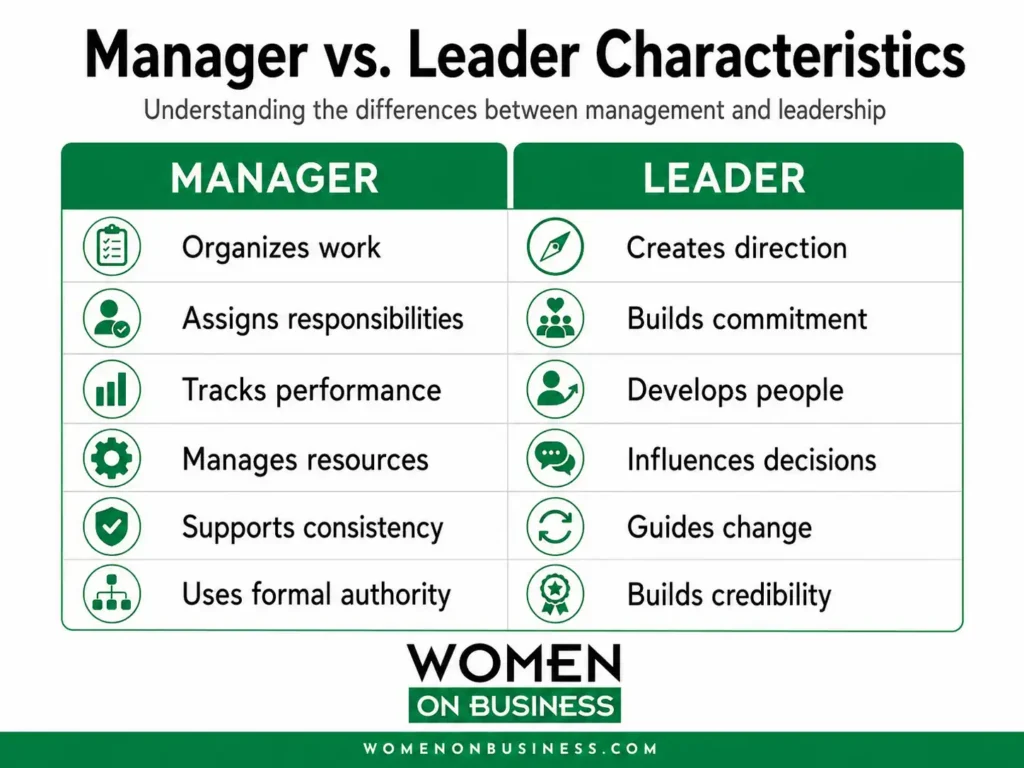
Characteristics of a Manager and a Leader at a Glance
The following overview shows where management and leadership responsibilities commonly differ.
|
Area |
Managerial Emphasis |
Leadership Emphasis |
|
Direction |
Converts goals into plans |
Helps shape and explain the destination |
|
Execution |
Coordinates tasks, budgets, and deadlines |
Sustains commitment to the work |
|
Authority |
Often comes from a formal position |
Grows through trust and credibility |
|
Performance |
Monitors progress and addresses gaps |
Develops people and expands capability |
|
Risk |
Protects quality, stability, and compliance |
Evaluates which risks are worth taking |
|
Communication |
Clarifies expectations and responsibilities |
Creates understanding and encourages dialogue |
|
Change |
Implements approved changes |
Helps people understand and influence change |
|
Decision-making |
Applies policies and available information |
Uses judgment when the answer is uncertain |
|
Time horizon |
Often focuses on current operations |
Considers future needs and possibilities |
|
Relationships |
Coordinates people around responsibilities |
Builds trust, alignment, and commitment |
The differences listed above are useful, but real work rarely fits into neat categories.
Consider a director whose company has lost a major client. She has to manage the immediate financial impact, adjust staffing plans, and revise forecasts. She also needs to lead. Employees may be worried about job security, frustrated by incomplete information, or uncertain about the company’s direction.
A spreadsheet can quantify the revenue loss. It can’t rebuild confidence. That requires credibility, communication, and visible decision-making.
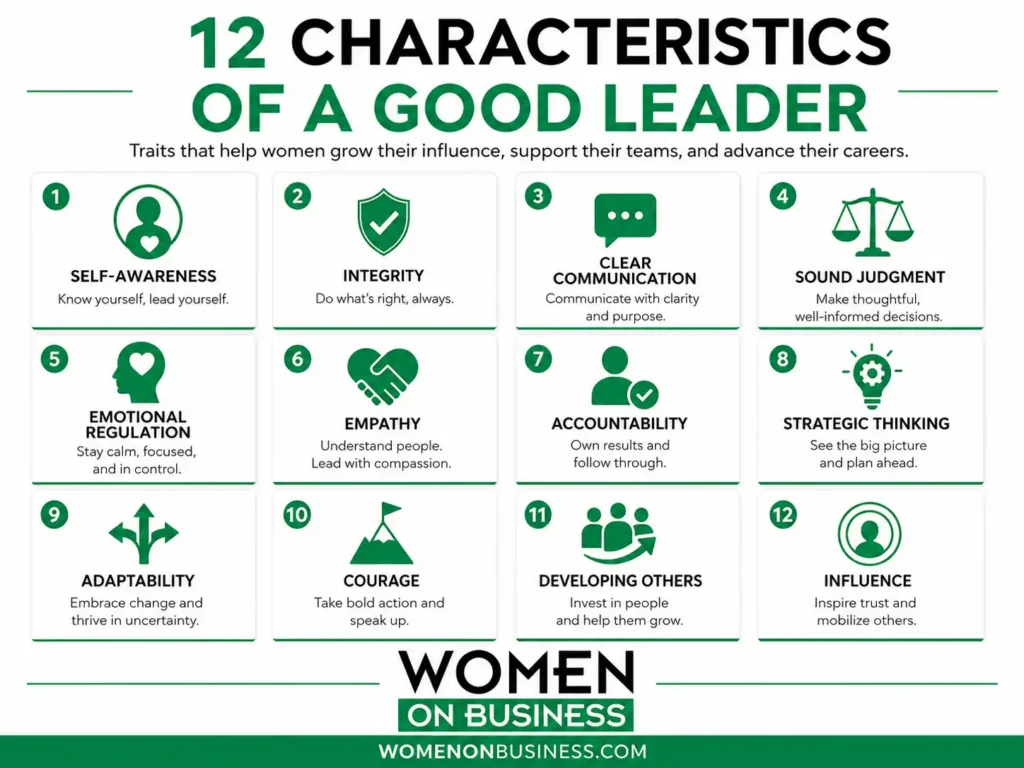
What Characteristics are Needed to Be a Good Leader?
Effective leadership is shaped by context. Leading an early-stage company requires different technical knowledge than directing a hospital department or managing a nonprofit program. Even so, several leadership characteristics are valuable across industries and career levels.
1. Self-Awareness
Self-awareness is the ability to understand your strengths, limitations, values, emotional patterns, and effect on other people.
This characteristic influences nearly every other leadership skill. You may believe that you communicate efficiently, while your team experiences your brief messages as impatient or dismissive. You may see yourself as supportive, while employees hesitate to approach you because you frequently interrupt them.
The Center for Creative Leadership identifies self-awareness as a foundational leadership capability. Effective leaders understand that intention and impact aren’t always the same.
You can strengthen self-awareness by reviewing your reactions after difficult interactions. Ask yourself what triggered your response, what assumptions you made, and how the conversation may have felt to the other person.
2. Integrity
Integrity means acting in ways that are consistent with your stated values and responsibilities.
Employees notice when a leader applies standards unevenly, takes credit for someone else’s work, conceals relevant information, or avoids responsibility for a poor decision. Those moments can weaken trust much faster than a motivational speech can build it.
Integrity also affects ordinary choices. A leader demonstrates it when she keeps a commitment, acknowledges uncertainty, corrects an inaccurate statement, and gives proper recognition to contributors.
People don’t expect leaders to be perfect, but they do expect honesty and accountability.
3. Clear Communication
Good leaders develop strong business communication skills so they can make complex issues understandable. They explain what has been decided, what remains uncertain, what employees are expected to do, and how the decision affects them.
Communication also involves listening. A leader who speaks clearly but doesn’t absorb information from others will miss valuable context.
For example, a vice president may announce a new hybrid work policy that appears reasonable from an executive perspective. During employee discussions, she learns that the required office days conflict with client schedules in one department. Listening allows her to address a practical flaw before it creates widespread frustration.
Strong communication reduces avoidable confusion while leaving room for questions and disagreement.
4. Sound Judgment
Leaders regularly make decisions with incomplete information. Sound judgment helps them evaluate evidence, recognize assumptions, consider consequences, and choose a responsible course of action.
Judgment grows through experience, but experience alone isn’t enough. A leader must be willing to examine what happened and update her thinking.
Suppose a business owner’s most successful service has started losing customers. She could assume the sales team needs to work harder. Better judgment would lead her to investigate customer feedback, pricing, competitor activity, service quality, and changes in buyer expectations before assigning blame.
Decisiveness is useful only when it’s supported by thoughtful evaluation.
5. Emotional Regulation
Leadership can involve conflict, criticism, missed targets, organizational politics, and decisions that affect people’s livelihoods. Emotional regulation allows a leader to respond deliberately instead of allowing a temporary reaction to control the conversation.
This doesn’t require hiding every emotion. A leader can express concern, disappointment, or urgency without creating fear or humiliating someone.
A manager who receives unexpected criticism in a meeting might feel defensive. Pausing, asking for an example, and returning to the issue after reflection usually produces a better result than arguing immediately.
Emotional steadiness helps other people remain focused when pressure rises.
6. Empathy
Empathy helps a leader understand another person’s experience, concerns, or perspective. It doesn’t mean agreeing with every request.
A compassionate manager may understand why an employee is struggling while still addressing missed deadlines. She can ask what’s interfering with performance, clarify what must improve, and determine whether additional support is appropriate.
Empathy strengthens decision-making because it reveals information that metrics may not capture. It also makes difficult conversations more constructive.
7. Accountability
Accountable leaders take responsibility for decisions, expectations, and results. They don’t make employees carry the consequences of unclear direction or unrealistic planning.
Accountability must include follow-through. When a leader says she’ll investigate a concern, employees notice whether she returns with an answer.
It also involves holding other people responsible in a fair and timely way. Avoiding a performance problem may feel considerate in the moment, but the delay can increase the burden on reliable employees who have to compensate for unfinished work.
8. Strategic Thinking
Strategic thinking connects present decisions with future outcomes.
A strategic leader examines patterns, dependencies, customer needs, organizational capabilities, and possible changes in the operating environment. She asks how today’s choices could affect the business six months or several years from now.
For example, approving every urgent client request may increase short-term revenue. It could also exhaust employees and create an unprofitable service model. Strategic thinking helps the leader assess the larger system rather than treating each request as an isolated decision.
9. Adaptability
Plans change. Technology evolves, employees leave, customer expectations shift, and economic conditions affect available resources.
Adaptability allows a leader to revise her approach without abandoning the underlying goal. She can absorb new information, acknowledge when an assumption was wrong, and help others understand why a change is necessary.
The Center for Creative Leadership includes learning agility among the core skills that leaders need throughout their careers. Learning-agile professionals draw lessons from experience and apply them under new conditions.
Adaptability shouldn’t look like constant indecision. Employees need enough consistency to plan their work. Effective leaders explain what changed and why the adjustment makes sense.
10. Courage
Leadership courage appears when someone raises an overlooked concern, challenges an unrealistic target, handles a sensitive problem, or makes an unpopular decision that serves the organization’s legitimate interests.
For women in business, courage may also involve taking up appropriate space in discussions where their expertise is underestimated. It can mean stating a recommendation without weakening it through unnecessary apologies or excessive qualifications.
Courage becomes more credible when it’s supported by evidence and preparation.
11. Ability to Develop Others
A leader’s impact grows when other people become more capable.
Developing employees includes coaching, sharing context, delegating meaningful work, providing useful feedback, and creating opportunities for people to practice new skills.
Leaders can also improve work performance by setting clearer expectations, removing avoidable obstacles, and helping employees focus on the priorities that matter most.
Picture a manager who’s preparing a talented employee for greater responsibility. Rather than assigning only familiar tasks, she asks the employee to lead part of a client presentation. They discuss the objective beforehand and review the experience afterward. The assignment creates value because responsibility is paired with guidance.
Development requires patience. Doing everything yourself may feel faster today, but it limits the team’s capacity tomorrow.
12. Influence
Influence is the ability to gain support for an idea or course of action. It relies on credibility, relationships, communication, and an understanding of what matters to other stakeholders.
This skill is crucial for professionals who work across functions or lead without formal authority.
A project manager may need cooperation from finance, technology, legal, and operations. She can’t simply order every department to follow her preferred schedule. She must explain the business need, address competing priorities, and create a workable agreement.
Influence helps women contribute at a higher level before receiving their next promotion. It shows that they can move work through an organization rather than succeeding only within their own assignments.
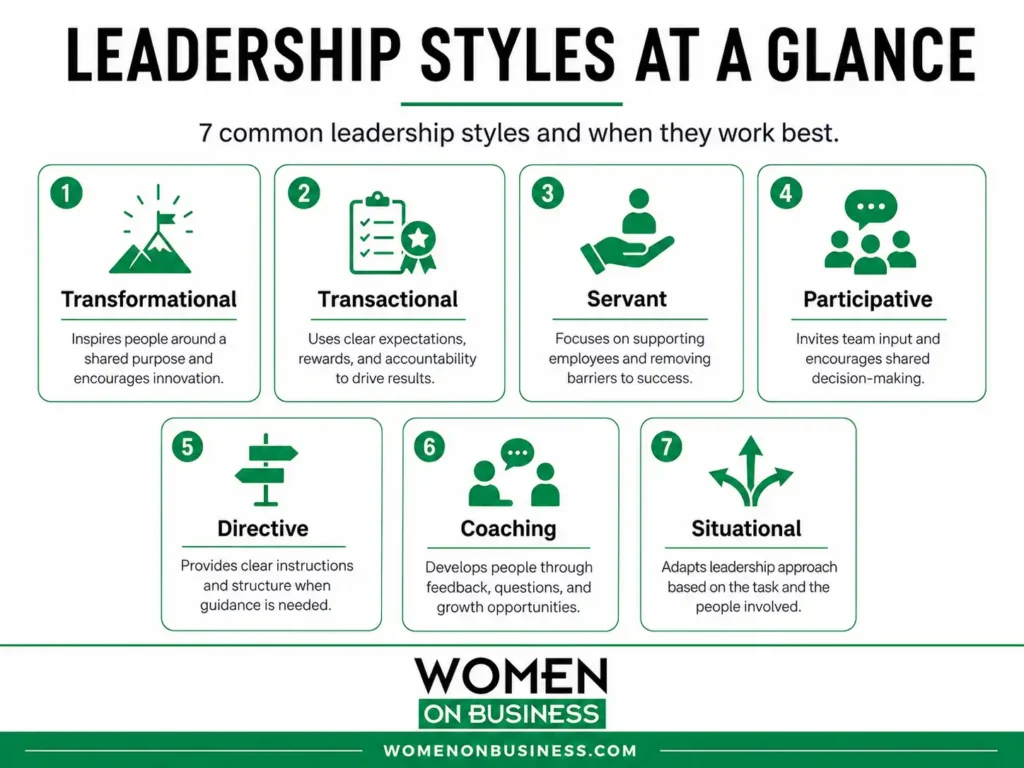
Different Styles of Leadership
Leadership style describes the way a person guides decisions, communicates with others, and responds to the needs of a group.
There isn’t one style that works in every situation. Leadership theories increasingly recognize that effectiveness depends on the task, the people involved, and the surrounding conditions.
Transformational Leadership
Transformational leaders inspire people around a shared purpose and encourage them to improve existing approaches. This style can be valuable during growth, innovation, or cultural change.
It works best when the vision is paired with practical direction. Inspiration without resources or realistic planning can leave a team energized but unable to execute.
Transactional Leadership
Transactional leadership emphasizes expectations, responsibilities, rewards, and consequences. It can be effective when work requires consistency, measurable standards, or close compliance.
A payroll manager, for example, must establish clear procedures and deadlines. Employees need to understand exactly what is required because mistakes can affect paychecks, taxes, and legal obligations.
Overreliance on transactions may make work feel mechanical, so this style is often strongest when combined with development and meaningful communication.
Servant Leadership
Servant leaders focus on helping employees succeed and removing barriers that interfere with their work. They listen closely, share credit, and consider the long-term development of others.
This approach can build trust, but service shouldn’t become self-erasure. Leaders still need to set boundaries, make decisions, and protect their own capacity. The Center for Creative Leadership notes that sustainable servant leadership requires attention to both other people and the leader’s own needs.
Democratic or Participative Leadership
Participative leaders invite employees to contribute ideas and information before decisions are made. This style can improve the quality of a decision when team members hold specialized knowledge.
It can also strengthen commitment because people understand how the decision developed.
Participation doesn’t require endless consensus. The leader should clarify who will make the final decision and when discussion must end.
Directive Leadership
Directive leaders provide specific instructions, priorities, and standards. This approach is useful during emergencies, when a task is unfamiliar, or when mistakes would create serious risk.
A newly hired employee may initially need detailed guidance. As her competence grows, excessive direction could become restrictive.
The leader’s responsibility is to match the level of direction to the person and situation.
Coaching Leadership
Coaching leaders help people improve through questions, observation, feedback, and appropriately challenging assignments.
Instead of immediately solving an employee’s problem, a coaching leader might ask what options the employee has considered and which risks each option creates. This process builds judgment and confidence.
Coaching takes time, which makes it less suitable for every urgent decision. It’s especially useful when long-term capability matters more than immediate convenience.
Situational Leadership
Situational leadership adjusts the leader’s behavior according to the demands of the task and the readiness of the people involved.
An experienced employee handling familiar work may need autonomy. The same employee could need more support when taking responsibility for a new and politically sensitive project.
Flexibility is the defining feature of this approach. The leader pays attention to what the situation requires instead of relying on a favorite style.
This approach is based on the idea that effective leaders vary the amount of direction and support they provide according to the task and the readiness of the people involved.
How to Improve as a Leader
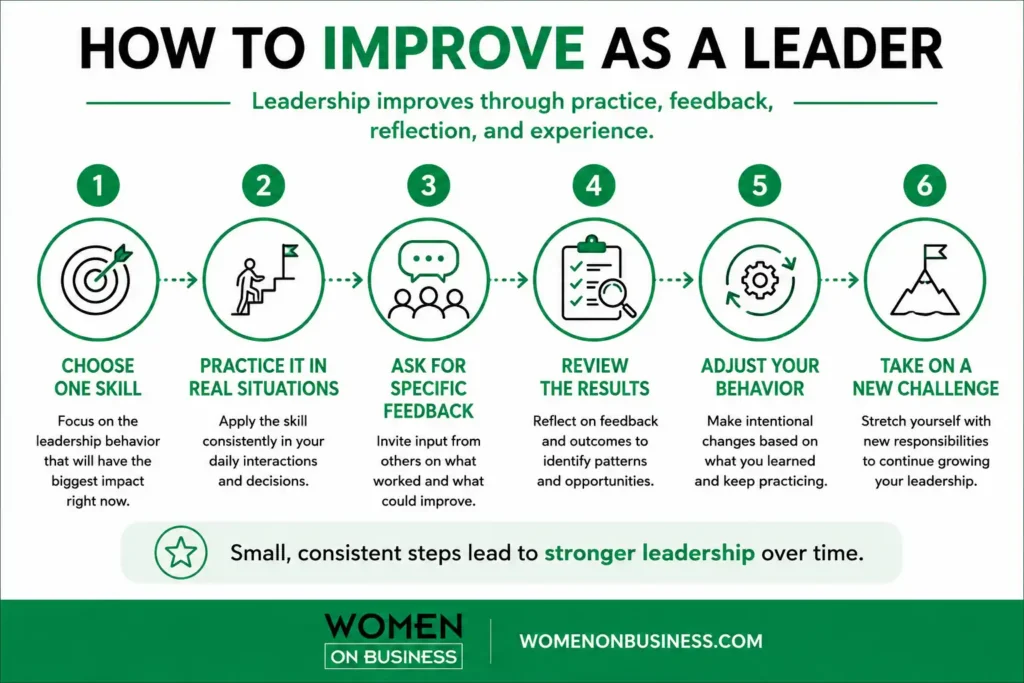
Leadership development works best when it’s connected to real behavior. Education can increase your understanding, but progress becomes visible when you apply what you’ve learned in meetings, decisions, conversations, and assignments.
Commit to Continuous Learning
Choose one leadership capability that would meaningfully improve your current performance. Narrow focus creates more useful practice than trying to transform every habit at once.
You might decide to improve delegation. For the next month, identify assignments that another employee can own, explain the desired outcome, agree on checkpoints, and resist taking the work back at the first sign of difficulty.
Learning can come from courses, books, mentors, professional associations, stretch assignments, and observation. Pay attention to leaders who create trust and clarity. Study the specific behaviors that make them effective.
You can also learn from poor leadership. Consider what happened, how it affected the group, and what you would do differently.
Seek Specific Feedback
General questions often produce general reassurance. Asking, “Do you think I’m a good leader?” makes it difficult for the other person to offer useful information.
Ask about observable behavior instead.
You might say, “During project meetings, what could I do to make it easier for people to raise concerns?” Another useful question is, “When I delegate work, where am I providing too much direction or too little context?”
Feedback from supervisors, peers, employees, and clients can reveal different aspects of your leadership. A structured 360-degree assessment collects input from multiple groups and can help leaders compare their self-perception with the way others experience their behavior.
Avoid defending yourself while receiving feedback. Ask for an example, thank the person, and take time to evaluate what you heard. One comment may reflect an isolated preference. A recurring pattern deserves close attention.
Implement Change Through Small Experiments
Insight doesn’t improve leadership until behavior changes.
Turn feedback into a specific experiment. Suppose colleagues tell you that you move through meetings so quickly that discussion feels discouraged. For the next four meetings, send major questions in advance and pause before finalizing each decision. Afterward, ask one trusted participant whether the new approach improved the conversation.
Small experiments make development manageable. They also produce evidence about what works.
Keep a brief leadership journal during the process. Record the situation, what you tried, how people responded, and what you’ll adjust next time. This creates a practical record of your development.
Expand Your Experience
Leadership skills become stronger when they’re tested in different settings.
Volunteer to lead a cross-functional initiative, facilitate a difficult discussion, mentor a colleague, present a recommendation to executives, or manage a project with unfamiliar stakeholders. Choose assignments that stretch your abilities without creating an unreasonable risk for the organization.
You don’t have to wait until you feel completely prepared. Growth often requires entering a situation with enough knowledge to begin and enough humility to keep learning.
Build a Personal Advisory Network
Career development becomes easier when you have trusted people who can offer perspective.
Your advisory network might include a mentor who understands your industry, a peer who sees your daily behavior, a sponsor who can advocate for your advancement, and a colleague whose strengths differ from yours.
Bring real questions to these relationships. Ask how they would approach a difficult stakeholder, which skill you should develop for the next level, or how your communication may be perceived in an executive setting.
Useful guidance is usually more specific than encouragement alone.
Frequently Asked Questions About Characteristics of a Manager and a Leader
What are the main characteristics of a manager and a leader?
A manager needs organization, reliability, communication, problem-solving ability, accountability, and attention to execution. A leader also needs self-awareness, integrity, judgment, empathy, adaptability, courage, strategic thinking, and the ability to influence and develop others.
The strongest professionals combine these qualities according to the needs of the situation.
Can someone be a good manager but a poor leader?
Yes. A person may be skilled at scheduling, budgeting, assigning work, and enforcing procedures while struggling to build trust or explain the purpose behind decisions.
This manager might deliver acceptable short-term results, but the team may become disengaged or overly dependent on instructions. Leadership development can help the manager strengthen communication, self-awareness, coaching, and influence.
Can you be a leader without being a manager?
Yes. Leadership is demonstrated through behavior and influence.
An employee can lead by improving a process, mentoring colleagues, bringing people together around a solution, or raising an important issue that others have avoided. Informal leadership experience can also prepare someone for future management opportunities.
Is leadership more important than management?
Both are necessary. Leadership helps people understand the direction and commit to it. Management turns that direction into coordinated action.
The balance changes by situation. A stable, highly regulated operation may require strong managerial discipline. A company facing major disruption may need more leadership around direction, trust, and adaptation.
What leadership characteristics are most important for women’s career success?
Self-awareness, strategic communication, influence, sound judgment, confidence, adaptability, and relationship-building are particularly valuable for advancement.
Women should also learn to make their accomplishments visible in an appropriate way. Decision-makers can’t recognize contributions they don’t know about. Share results clearly, explain their business value, and document how your work supports organizational goals.
What is the best leadership style?
No single leadership style is always best. The right approach depends on the work, the employee’s experience, the urgency of the situation, and the consequences of the decision.
A strong leader may use a coaching style during employee development, a participative approach while exploring a new strategy, and a directive style during an immediate safety problem.
How can I demonstrate leadership before receiving a promotion?
Take ownership of problems within your influence. Communicate solutions thoughtfully, support colleagues, share useful information, and follow through on commitments.
Look for opportunities to lead projects or improve processes. You can also strengthen your visibility by presenting recommendations, facilitating meetings, or representing your department in cross-functional work.
How long does it take to become a better leader?
Leadership development is continuous, but a person can improve a specific behavior within weeks when she practices deliberately and seeks feedback.
Deeper changes involving judgment, emotional patterns, or strategic thinking usually develop over a longer period. Progress should be evaluated through changes in behavior and results rather than the amount of training completed.
Leadership is a Career-Long Practice
The characteristics of a manager and a leader aren’t reserved for executives. They appear in the way you make decisions, communicate under pressure, respond to feedback, treat colleagues, and take responsibility for results.
Management gives work the structure it needs. Leadership helps people bring judgment, energy, and commitment to that structure.
Your next step doesn’t need to be dramatic. Choose one characteristic that would improve your current effectiveness. Ask for specific feedback, practice a new behavior, and observe the effect it has on others.
Those repeated choices shape your reputation. Over time, they also shape the kind of leader you become.
References
- American Psychological Association. “Leadership Theories.” APA Dictionary of Psychology.
- American Psychological Association. “Situational Leadership Theory.” APA Dictionary of Psychology.
- Center for Creative Leadership. “What Is Leadership? A Definition Based on Research.”
- Center for Creative Leadership. “How to Increase Your Self-Awareness.”
- Center for Creative Leadership. “4 Core Leadership Skills Every Leader Needs.”
- Center for Creative Leadership. “How to Make Servant Leadership More Sustainable.”
- Center for Creative Leadership. “360 Degree Assessment Feedback Best Practice Guidelines.”
- Gallup. “Managers Account for 70% of Variance in Employee Engagement.”
