
Companies are spending heavily to win the artificial intelligence race. When it comes to AI at work, employees may be the ones paying for it.
Recent workplace research paints a troubling picture of how some businesses are approaching AI adoption. Companies are cutting compensation and jobs to free up money for AI investments. At the same time, many workers say they’re receiving little training, limited guidance, and inadequate access to employer-provided AI tools.
So, employees are filling the gaps themselves.
They’re learning AI outside of work. They’re paying for training. They’re signing up for their own AI tools. They’re worrying that coworkers who learn faster will pass them by.
Taken together, the data suggest that businesses aren’t simply investing in AI. In many cases, they’re transferring part of the cost and risk of AI adoption to their employees.
Key Takeaways
- 54% of companies surveyed have reduced or plan to reduce employee compensation to fund AI investments in 2026, while 26% have used or expect to use layoffs.
- Among companies already cutting compensation or jobs to fund AI, 92% say AI investment is currently a higher priority than employee satisfaction.
- 41% of workers say their employers have provided no tools, training, or guidance to prepare them to use AI at work, while just 19% report receiving comprehensive AI training.
- 43% of workers believe their AI skills are behind what they need to stay competitive, and 37% feel pressure to improve those skills on their own time.
- 30% say they’re likely to spend their own money learning AI skills because they’re afraid of falling behind.
- Meanwhile, weak organizational oversight is creating another problem. 35% of workers who use AI say they rarely or only occasionally review its output before using it.
Companies Are Finding AI Money in Employee Budgets
Perhaps the most startling findings come from a 2026 ResumeBuilder.com survey of 866 U.S. business leaders.
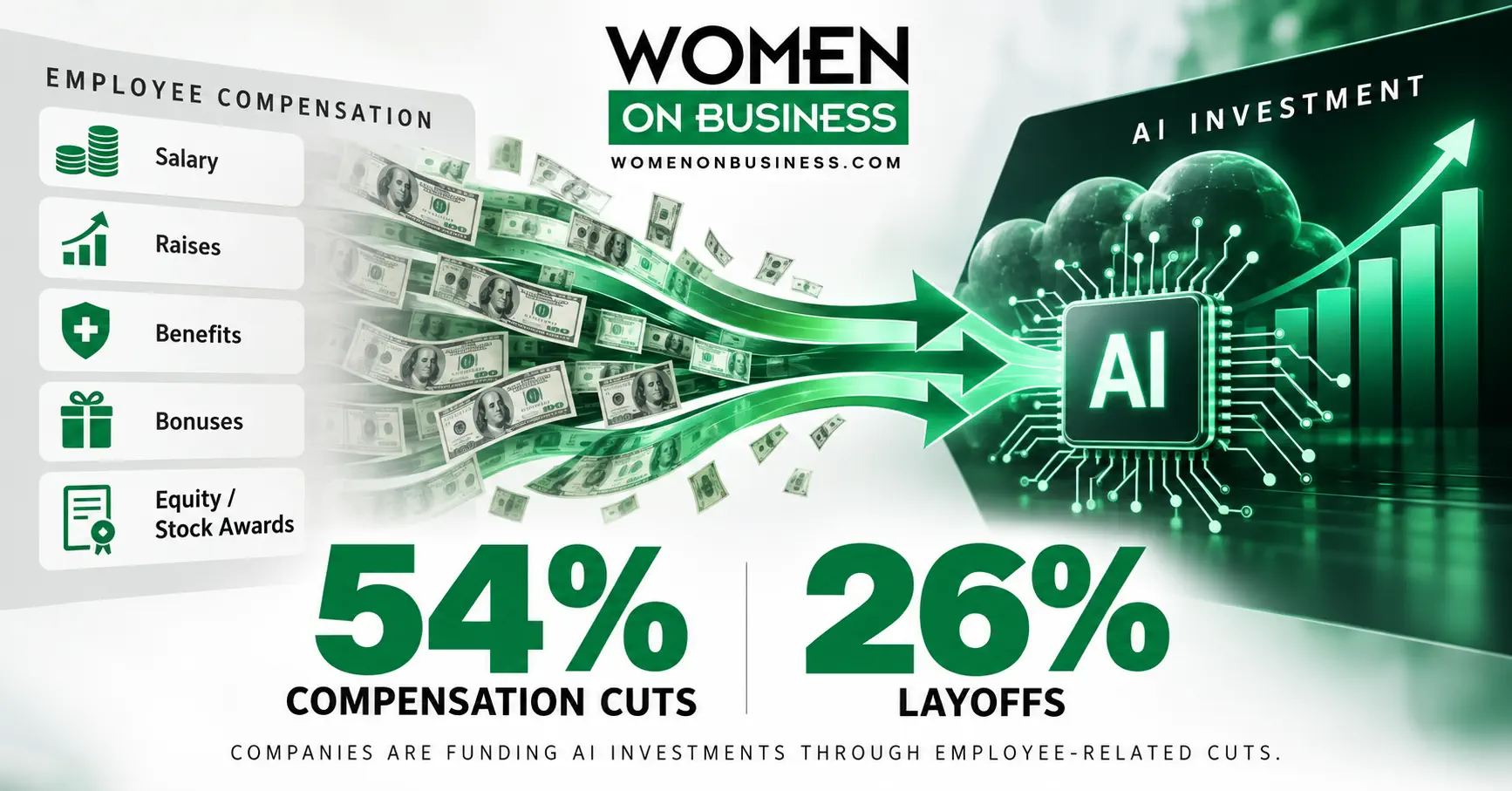
According to the survey, 54% of companies have reduced or plan to reduce employee compensation to free up capital for AI spending in 2026. Another 26% have conducted or expect to conduct layoffs to help fund AI investments. By the end of the year, 58% will have done at least one of the two.
The compensation reductions aren’t limited to bonuses. Among companies making cuts, 61% have targeted bonuses, 60% equity or stock awards, 59% raises, 53% benefits, and 43% base salaries.
Think about what that means if you’re an employee being told that AI will make your organization more productive.
The company may benefit from future productivity gains and revenue growth, while you receive a smaller raise, reduced benefits, fewer stock awards, or possibly a pink slip to help pay for the technology expected to produce those gains.
The priorities become even clearer when you look at the subset of surveyed companies already cutting compensation or conducting layoffs to fund AI. Among those employers, 92% said AI investment is currently more important than employee satisfaction; 94% said they’re willing to accept higher turnover to fund AI growth, and 88% said the weak job market makes it easier to reduce compensation without losing talent.
That last number deserves some more attention.
A weak labor market isn’t simply affecting hiring decisions. According to these business leaders, it’s giving companies greater confidence that employees will tolerate financial sacrifices they might reject in a stronger job market.
Employees Are Expected to Catch Up Without Enough Help
Cutting employee spending to fund technology might be easier to defend if companies were making equally aggressive investments in preparing their people to use that technology.
Another set of findings suggests many aren’t.
A Resume Now survey of 1,020 employed U.S. adults found that 41% said their employers had provided no tools, training, or guidance to prepare them to use AI at work. Only 19% reported receiving comprehensive AI training with dedicated time or resources.
Even access to technology is inconsistent. More than half of workers said their employers provided either no AI tools or only free, publicly available tools.
As a result, employees have started solving the problem themselves.
A remarkable 76% said they’d used AI tools they personally found and signed up for to complete work tasks. Nearly one-quarter use personally sourced tools every day.
That’s a significant shift in responsibility. If your employer expects AI-enhanced productivity but doesn’t provide sufficient tools and training, you’re effectively being asked to build and pay for part of the company’s AI infrastructure yourself.
The AI Skills Gap Is Following Workers Home
The pressure doesn’t end when the workday does.
In Resume Now’s AI Skills Race Report, 43% of workers said their AI skills were behind where they needed to be to remain competitive. Thirty-five percent worried that inadequate AI skills could hurt their job security, and 39% worried coworkers who adopt AI faster would gain a workplace advantage.
For 37%, that pressure is following them into their personal time. They said they feel pressure to develop AI skills outside of work to keep up with coworkers or avoid falling behind.
Money is following them out the door, too. The AI-Whelmed Worker Report found that 30% of employees are likely to spend their own money learning AI skills because they’re concerned about falling behind. Forty-four percent feel overwhelmed by pressure to learn and use AI at work, while the same percentage say they don’t have a clear path for building their AI skills.
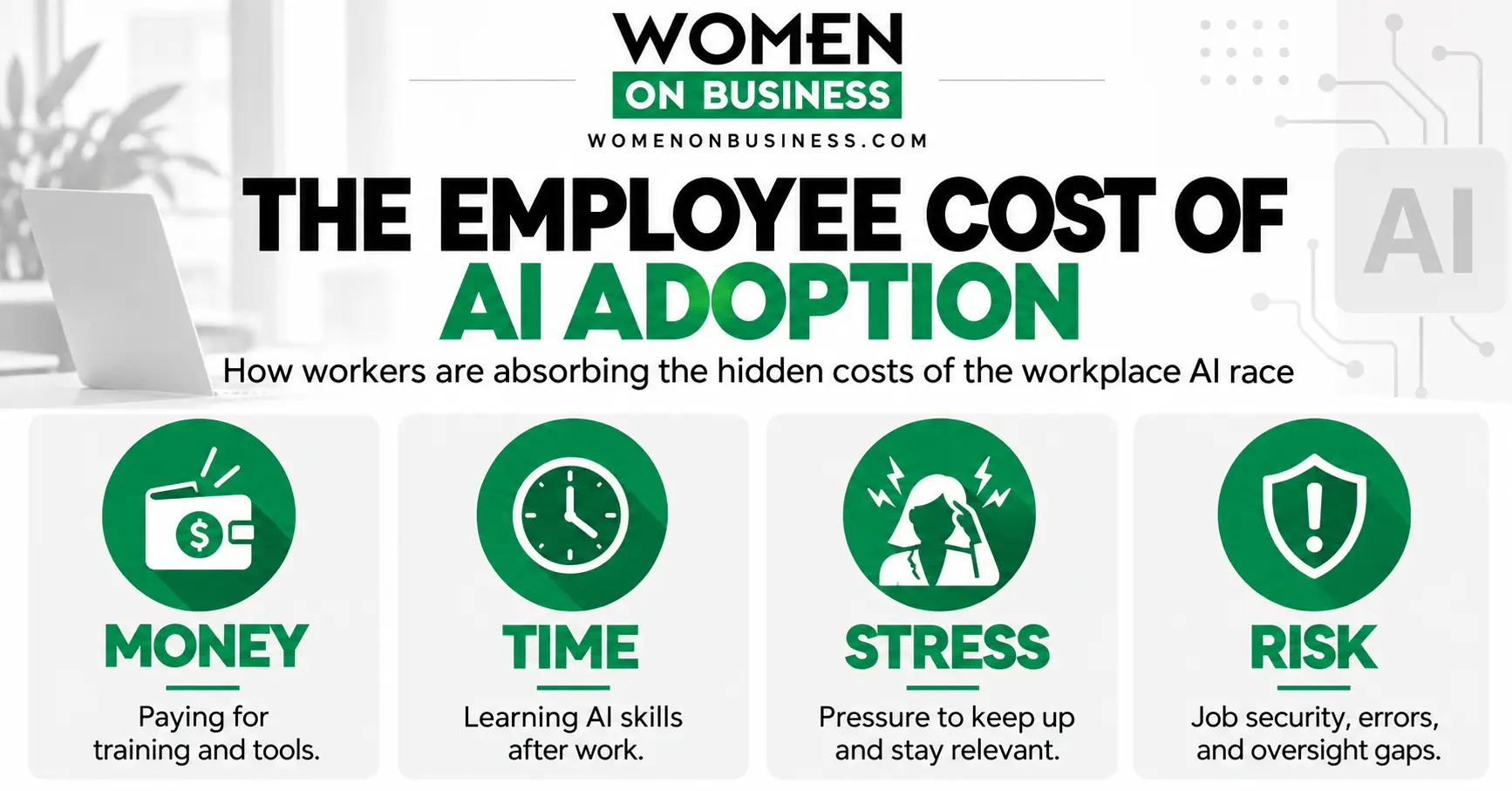
Employees are increasingly paying for the AI transition in four currencies: money, time, stress, and risk.
That’s a heavy burden when the employer expects to capture much of the eventual productivity gain.
Poor AI at Work Support Is Creating Business Risk Too
Leaving workers to navigate AI independently doesn’t just affect employees. It can create serious problems for the business.
Resume Now’s AI Oversight Gap Report found that 35% of workers who use AI rarely or only occasionally review AI-generated output before using it. Eighteen percent said they usually trust the output as-is. Another 17% only check it when something looks wrong.
Put that alongside the finding that 76% have used personally sourced AI tools for work, and companies face an obvious governance challenge.
Employees may be putting company information into unapproved tools. AI-generated errors can move into documents and decisions without adequate review. Managers may not even know which tools are being used.
These problems aren’t evidence that employees can’t be trusted with AI. They’re evidence that organizations need to manage technological change rather than simply demand it.
AI Adoption Is Growing, Especially at Larger Companies
None of this means companies should ignore AI.
The U.S. Census Bureau’s Business Trends and Outlook Survey found that overall business AI use hovered between 17% and 20% from December 2025 through May 2026. Adoption was substantially higher among larger employers. In May, 37% of firms with at least 250 employees reported using AI, as did 32% of companies with 100 to 249 employees.
Resume Now’s state-level analysis of Census Bureau data shows that adoption remains uneven geographically. Reported business AI use ranged from a high of 27.7% in Washington, D.C., and 24.4% in Arizona to a low of 13.5% in West Virginia during the first half of 2026.
There’s also evidence that support matters. Gallup reports that employees whose managers actively support AI use are nearly twice as likely to use it frequently and seven times as likely to say AI helps them do what they do best.
That’s the missed opportunity in much of this data.
Businesses need to invest in AI. They also need to invest in the people expected to turn that technology into business results.
What This Means for You at Work
If you’re an employee, don’t assume AI expectations will automatically come with formal training. Ask what tools are approved, what data can be entered into them, how AI-generated work should be reviewed, and which AI capabilities actually matter for your role.
Document the AI skills you’re developing and, more importantly, the business results they help you achieve. Saving five hours a week, improving customer response times, finding insights faster, or reducing repetitive work tells a stronger career story than simply listing ChatGPT or another AI product among your skills.
If you’re a manager or business leader, the lesson is even more important.
You can’t build a sustainable AI strategy by purchasing technology but still treating employee preparation as somebody else’s problem. Training employees during paid work time, providing secure tools, establishing practical policies, and rewarding people for learning are investments in AI adoption, too.
Companies may be racing to build AI capabilities, but technology doesn’t operate in an organizational vacuum.
The businesses most likely to benefit over the long term won’t simply be the ones that spend the most on AI. They’ll be the ones that understand the people using it are part of the investment.
Frequently Asked Questions About AI at Work
Are companies cutting employee pay to invest in AI at work?
Some are. A 2026 ResumeBuilder.com survey found that 54% of surveyed companies had reduced or planned to reduce employee compensation to help fund AI investments. The cuts included bonuses, raises, benefits, equity awards, and base salaries. That doesn’t mean every company is taking this approach, but it does show that AI spending is directly competing with employee compensation in some organizations.
Is AI causing companies to lay off employees?
AI is one factor behind some workforce reductions. In the same ResumeBuilder.com survey, 26% of companies said they had conducted or expected to conduct layoffs to help fund AI investments. AI may also contribute indirectly by allowing companies to automate tasks, restructure roles, or expect smaller teams to produce more.
Are employers responsible for providing AI training?
There isn’t one universal rule requiring employers to provide AI training, but businesses have a strong practical reason to do so. Employees are being asked to use AI tools that can affect productivity, data security, accuracy, and decision-making. Training employees during paid work time, providing approved tools, and setting clear policies can reduce mistakes while helping companies get more value from their AI investments.
Should employees learn AI skills on their own time?
You may decide that developing AI skills independently is worthwhile for your career, but employers shouldn’t assume workers will shoulder the entire burden themselves. Research from Resume Now found that 37% of workers feel pressure to develop AI skills outside of work, while 30% are likely to spend their own money learning AI because they’re worried about falling behind. Ideally, employers should provide at least some training, time, and support.
What can employees do to protect their careers as AI at work use grows?
Focus on learning how AI can improve the work you already do rather than trying to master every new tool. Ask which tools your employer approves, understand what information can safely be entered into them, and verify AI-generated output before using it. Most importantly, document the business results your AI skills help produce, such as time saved, better analysis, stronger customer service, or improved productivity. Those outcomes are more valuable than simply saying you know how to use AI.
