
Artificial intelligence is changing what employers expect from employees, and those expectations are starting to affect something workers care deeply about. Their paychecks. In fact, the connection between AI skills and employee compensation is already tighter than you might think.
A new survey from financial services recruitment firm Selby Jennings reveals that companies are increasingly connecting employees’ AI skills to compensation, promotions, and performance evaluations. Meanwhile, many employers admit they don’t know how to evaluate those skills accurately.
The findings raise important questions for employees and business leaders across industries. If AI proficiency becomes a requirement for career advancement, how will companies measure it? Will employees receive the training they need? And what happens to experienced professionals whose valuable skills aren’t directly related to AI?
Key Takeaways
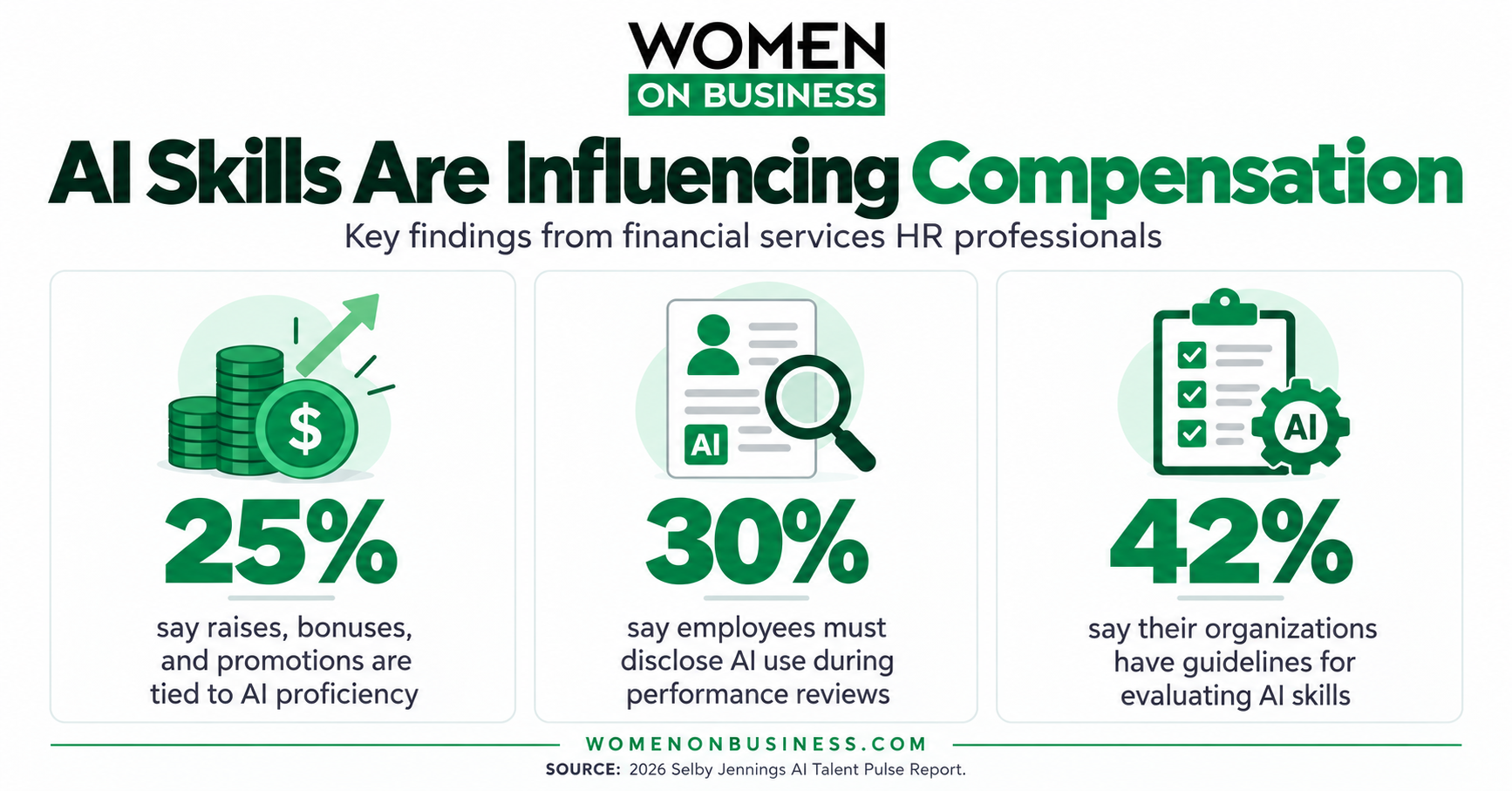
- 25% of surveyed financial services HR professionals say their organizations have tied raises, bonuses, and promotions to AI proficiency.
- 30% report that employees must disclose AI use during formal performance reviews.
- 42% say their organizations have established guidelines for evaluating employees’ AI skills.
- 31% identify the lack of qualified internal evaluators as their biggest obstacle to hiring AI-enabled talent.
- AI skills are becoming increasingly valuable, but employees and employers need clear expectations, relevant training, and meaningful performance measures.
AI Skills and Employee Compensation Are Already Connected
The Selby Jennings AI Talent Pulse Report, published in October 2026, surveyed 500 U.S. financial services HR professionals between August 19 and August 26, 2026. The results suggest that AI proficiency is moving beyond a desirable skill on a resume and becoming part of how companies evaluate and reward employees.
According to the report:
- 25% say their organizations have connected raises, promotions, and bonuses to AI proficiency.
- 30% require employees to disclose their AI use during performance reviews.
- 42% have developed guidelines for evaluating employee AI skills.
- 30% have created roles or departments responsible for demonstrating the return on investment (ROI) from AI.
These findings are specific to financial services, so they shouldn’t be interpreted as evidence that the same practices are equally common across all industries. However, they’re an important indication of how workplace expectations could evolve as more companies invest in AI.
Consider what this means for your next performance review. You could be evaluated on how effectively you use AI to complete your responsibilities, even if AI wasn’t mentioned in your job description when you were hired.
That represents a significant change in how employee performance is measured.
Companies Want AI Skills but Struggle to Define Them
One of the most concerning findings from the Selby Jennings report is how unprepared many companies are to evaluate the AI skills they’re increasingly demanding.
The survey found that:
- 16% of respondents don’t know what “AI-enabled” means for the positions they’re filling.
- 19% repeatedly hire candidates with the wrong qualifications.
- 23% can’t find anyone internally who has performed the AI-related work they’re hiring for.
- 31% say their biggest obstacle to hiring AI-enabled talent is the absence of someone internally who can confidently evaluate candidates.
- 50% report an increase in the proportion of underqualified candidates they’ve interviewed over the previous year.
Think about that for a moment. Companies are placing greater value on AI proficiency while some don’t have a clear understanding of which skills employees need or how to assess them.
This creates problems for everyone. Employees may spend time learning tools that aren’t relevant to their responsibilities. Job candidates may struggle to demonstrate their abilities. Managers may evaluate performance inconsistently because they haven’t received adequate guidance themselves.
For women already navigating workplace inequalities, unclear evaluation criteria could introduce another barrier to career advancement.
As discussed in 10 Career Advancement Strategies for Women to Move Ahead at Work, demonstrating your contributions and making your accomplishments visible are important parts of professional growth. Those practices become even more valuable when employers introduce new performance requirements.
Another Survey Reveals How Much Employers Value AI Proficiency
Additional research from PwC suggests that the growing importance of AI skills could have significant consequences for employee compensation.
The 2026 PwC Financial Services Workforce AI Survey, which surveyed more than 1,000 leaders at U.S. financial services firms, found that:
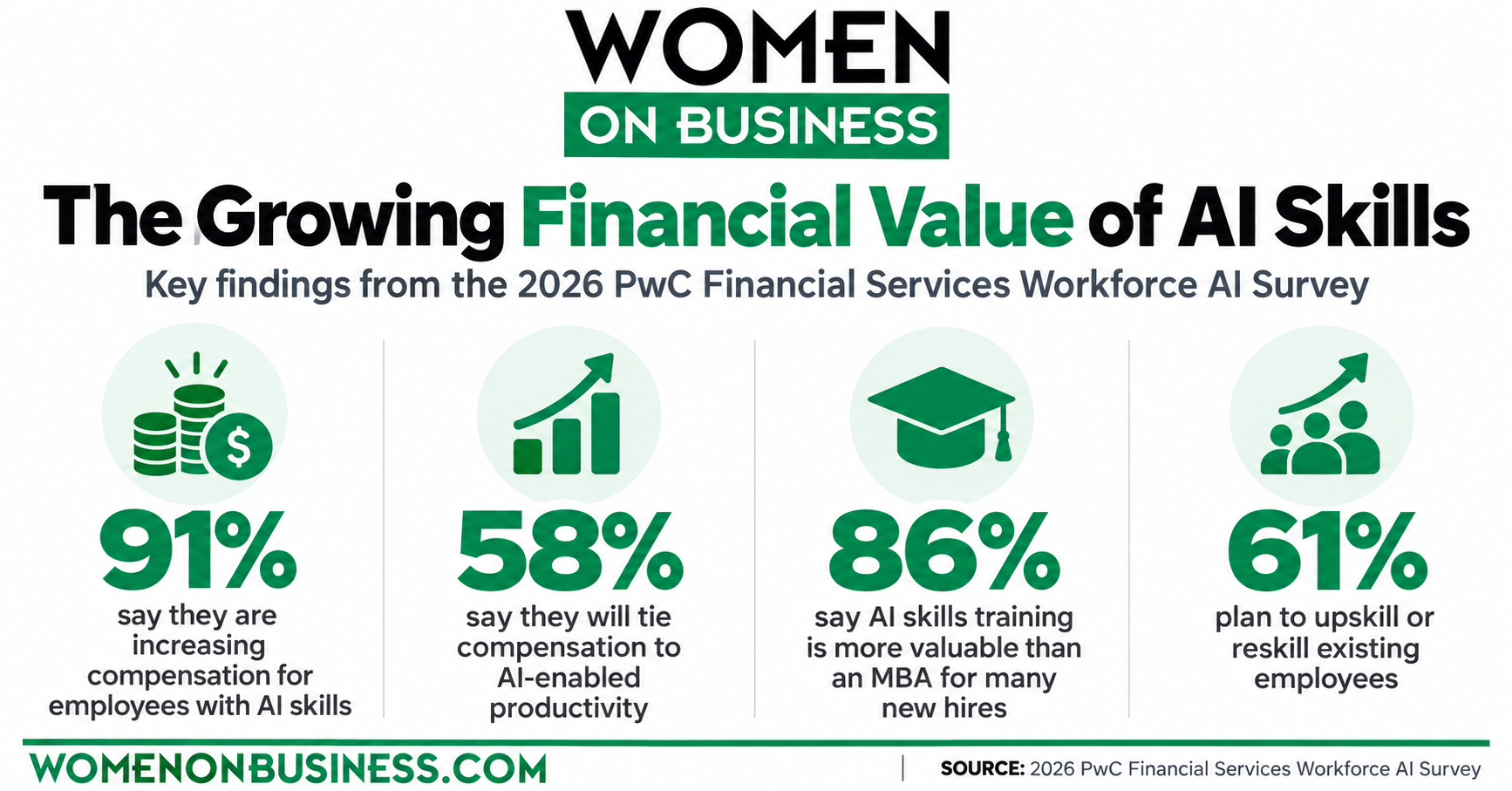
- 91% say they’re increasing compensation for employees with AI skills.
- 58% say they’ll tie compensation directly to AI-enabled productivity.
- 86% agree that AI skills training is more valuable than an MBA for many new hires.
- 62% plan to hire employees with AI-specific skills in the coming year.
- 61% plan to upskill or reskill existing employees.
The surveys measure different things. Selby Jennings examines practices reported by HR professionals, while PwC captures financial services leaders’ compensation strategies and plans.
Together, they suggest that AI proficiency is becoming an increasingly important factor in how financial services organizations attract, develop, and reward employees.
However, higher compensation for AI skills doesn’t guarantee higher salaries for every employee who learns to use AI. Your opportunities will depend on your role, your employer, and the value your skills deliver.
Employees Face More Pressure to Learn AI
The growing emphasis on AI proficiency creates another challenge. Who is responsible for ensuring employees develop the necessary skills?
In The Real Cost of AI at Work Is Falling on Employees, I examined research showing that employees are already absorbing significant costs associated with workplace AI adoption. Some workers are paying for their own AI tools and training while worrying that their colleagues will advance more quickly.
Now, research suggests that AI proficiency could influence compensation and career opportunities, adding even more pressure.
Imagine being told that your next raise depends partly on demonstrating AI proficiency, but your employer hasn’t explained which tools you should learn, provided training, or established clear evaluation standards. How can you meet expectations that haven’t been defined?
Employers need to address this problem before connecting compensation to AI capabilities. They should communicate which skills matter for specific positions, provide access to approved AI tools and training, and establish consistent performance measures.
Otherwise, employees with more personal resources, free time, or access to technology could have an advantage unrelated to their actual job performance.
What Employees Can Do to Protect Their Career Opportunities
You don’t have to become an AI expert to prepare for changing workplace expectations. However, you should understand how AI could affect your responsibilities and career prospects.
Here are five steps you can take.
1. Identify AI Skills Relevant to Your Position
Focus on tools and capabilities that can help you perform your actual responsibilities. For example, a marketing professional might use AI to analyze campaign results, while a human resources manager might use approved tools to summarize workforce data.
2. Ask How AI Proficiency Will Be Evaluated
Talk to your manager about whether AI skills will influence performance reviews, raises, or promotions. Ask which capabilities are expected, how they’ll be measured, and what training is available.
3. Document the Results of Your AI Use
Keep track of improvements you’ve achieved with AI, such as time saved, fewer errors, improved analysis, or stronger business results. Concrete outcomes provide better evidence of your contributions than simply reporting how frequently you use AI.
4. Continue Developing Human Skills
AI proficiency shouldn’t come at the expense of critical thinking, communication, leadership, or decision-making. In fact, those capabilities are essential for determining whether AI-generated information is accurate and appropriate.
Read 10 Human Skills AI Can’t Replace and How to Improve Them for practical ways to strengthen abilities that remain valuable as technology changes.
5. Make Your Professional Development Visible
Discuss new skills with your manager, volunteer for relevant projects, and explain how your work contributes to business goals. You want decision-makers to recognize both your technical capabilities and your broader professional value.
Employers Need to Measure Results, Not Just AI Usage
The Selby Jennings findings should also concern business owners and managers. Using AI frequently doesn’t necessarily mean an employee is more productive, accurate, or effective.
For example, an employee who uses AI to generate 10 reports that require extensive corrections may accomplish less than someone who creates five accurate reports using a combination of AI and professional judgment.
If you’re responsible for evaluating employees, develop performance standards based on meaningful results. Consider whether AI helps employees improve quality, reduce unnecessary work, solve problems, or deliver better customer experiences.
You should also ensure that employees have comparable opportunities to learn the skills you’re evaluating.
As explained in How to Improve Work Performance, better results often depend on clear expectations, appropriate resources, and practical support.
Those principles apply just as strongly to AI.
The Bottom Line
AI skills are beginning to influence compensation, hiring, and career advancement in financial services. Other industries may increasingly adopt similar practices as AI becomes more deeply integrated into business operations.
For employees, the message is clear. Developing relevant AI capabilities could create new professional opportunities, but knowing how to use a tool is only part of the equation. You also need to demonstrate the value of your work.
For employers, the challenge is equally important. If AI proficiency influences compensation and promotions, performance expectations must be clearly defined, consistently evaluated, and supported by training.
The success of workplace AI adoption will depend partly on whether companies invest in the people expected to use it.
Frequently Asked Questions
Are employers tying pay raises and promotions to AI skills?
Yes. A 2026 Selby Jennings survey found that 25% of surveyed financial services HR professionals reported that their organizations had tied raises, bonuses, and promotions to AI proficiency. This finding doesn’t establish how widespread the practice is across other industries.
What does AI proficiency mean in the workplace?
AI proficiency generally means understanding how to use artificial intelligence tools effectively, evaluate their outputs, recognize their limitations, and apply them responsibly to relevant work. Specific requirements vary by position and employer.
How can employees demonstrate AI skills during performance reviews?
Employees can provide examples of how they’ve used AI to improve productivity, accuracy, problem-solving, or business outcomes. Documented results and demonstrated judgment are more useful than simply listing AI tools they’ve used.
