A state can have plenty of job openings, competitive salaries, and a growing economy, but that doesn’t automatically make it a great place for women to build their careers. A new national ranking reveals just how complicated the relationship between location, employment opportunities, and career success can be.
According to WalletHub’s Best & Worst States for Jobs in 2026 report, Nebraska is the best state in the country for jobs, followed by North Dakota and Minnesota. Meanwhile, states such as Florida, Pennsylvania, and Oregon rank near the bottom.
The findings are particularly interesting when compared with other research about women’s employment, earnings, and workplace equality. Some states that perform well overall have significant disadvantages for women, while others offer a more favorable combination of job opportunities and economic conditions.
For women planning a career change, negotiating a salary, or considering relocation, these differences shouldn’t be ignored.
Key Takeaways
- Nebraska ranks #1 for jobs in 2026, followed by North Dakota, Minnesota, South Dakota, and New Hampshire.
- Minnesota stands out for women in business, ranking #3 for jobs and #4 in WalletHub’s separate 2026 ranking of the best states for women.
- Washington has the highest average monthly starting salary, while Texas ranks second. However, high salaries don’t necessarily translate into stronger economic opportunities for women.
- Florida ranks #47 overall and last for employment growth, despite some Florida cities performing well in separate research on women’s career opportunities.
- Job availability and job quality are different measures. Benefits, security, advancement opportunities, workplace protections, and commuting demands all influence career success.
- Businesswomen should evaluate the complete employment picture before accepting a position or relocating, including compensation, cost of living, flexibility, and long-term career prospects.
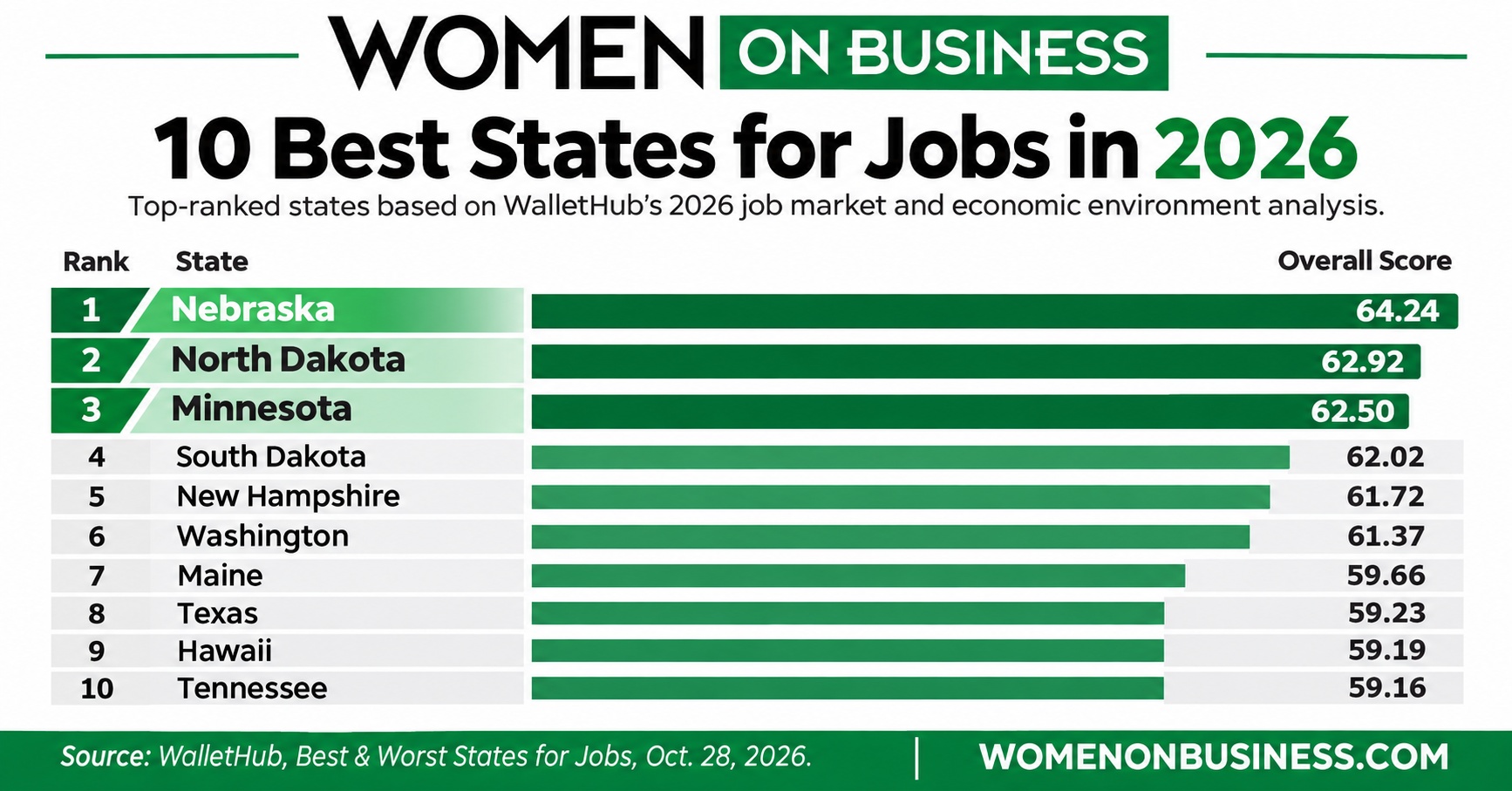
The 10 Best States for Jobs in 2026
WalletHub evaluated all 50 states using 34 indicators covering two categories, job market strength and economic environment. The job market category accounted for 60% of each state’s total score, while the economic environment accounted for 40%.
The analysis included employment growth, unemployment, salaries, job security, employee benefits, worker protections, and commuting times.
The 10 highest-ranking states are shown below.
|
Rank |
State |
Overall Score |
|
1 |
Nebraska |
64.24 |
|
2 |
North Dakota |
62.92 |
|
3 |
Minnesota |
62.50 |
|
4 |
South Dakota |
62.02 |
|
5 |
New Hampshire |
61.72 |
|
6 |
Washington |
61.37 |
|
7 |
Maine |
59.66 |
|
8 |
Texas |
59.23 |
|
9 |
Hawaii |
59.19 |
|
10 |
Tennessee |
59.16 |
Source: WalletHub, Best & Worst States for Jobs, October 28, 2026. Scores are based on a 100-point scale.
The results challenge the assumption that the largest states or most prominent business centers necessarily offer the strongest employment opportunities. In fact, the top five states include Nebraska, North Dakota, and South Dakota, where smaller labor markets outperform many larger states on the combination of measures that WalletHub evaluated.
Why Nebraska Ranks First
Nebraska earned the top position with a 3% unemployment rate, the 11th-most job opportunities per capita, and the third-best job security in the country.
The state also ranks fourth for employment growth and 10th for industry variety. Its relatively diverse employment base may provide more opportunities for workers who want to change employers or industries without relocating.
Benefits are another advantage. Nebraska has the fourth-highest share of employees with private health insurance.
For women in business, these findings suggest that strong career opportunities aren’t limited to major metropolitan areas. However, statewide employment conditions are only one part of deciding whether a location supports your professional goals.
A low unemployment rate won’t necessarily help you advance if there are few employers hiring for your particular occupation or limited opportunities to move into management.
Minnesota May Offer One of the Best Combinations of Job Opportunities and Conditions for Women
Minnesota is arguably one of the most interesting states in the 2026 rankings, particularly when the results are examined from a woman’s perspective. WalletHub ranks Minnesota third overall for jobs. The state also has the third-highest median household income in the country, adjusted for cost of living, at nearly $88,000.
Its average monthly starting salary is approximately $4,000, ranking 11th nationally. Minnesota also performs well on employee benefits, including private health insurance coverage and access to employer-based retirement plans.
Those findings become even more meaningful when compared with WalletHub’s Best & Worst States for Women in 2026 report, which ranked Minnesota fourth overall. In that separate study, Minnesota ranked second for median earnings among female workers after adjusting for cost of living. It also had the third-lowest percentage of women living in poverty.
This combination makes Minnesota particularly noteworthy. It performs well in the general employment market while also demonstrating relatively strong economic outcomes for women.
Of course, statewide rankings can’t tell you whether a specific employer offers equal pay or meaningful leadership opportunities. Still, Minnesota’s consistent performance across multiple measures makes it worth examining if you’re considering a career move.
The Highest Salaries Aren’t Always Found in the Best States for Women’s Careers
Salary is one of the first things most people consider when evaluating a job opportunity. WalletHub’s findings show why compensation deserves a closer look.
According to the report, the five states with the highest average monthly starting salaries are:
- Washington
- Texas
- New York
- Virginia
- Colorado
Washington’s average starting salary is approximately twice Alaska’s, which ranks last on this measure. That’s a substantial difference, but starting salaries don’t tell the entire story.
Washington ranks sixth overall for jobs and first for economic environment, yet only 35th for its job market. Texas ranks eighth overall, with the second-best economic environment but a job market ranking of 25th.
For someone already holding a competitive job offer, these states might offer attractive financial opportunities. For someone actively searching for work, the employment market may present a different picture.
There’s also a gender-related complication. In WalletHub’s separate 2026 study of the best states for women, Texas ranked 48th out of the 50 states and Washington, D.C. That study evaluated women’s economic and social well-being alongside health care and safety.
The contrast is significant. Texas may be attractive based on starting salaries and overall economic conditions, but the broader research suggests women should examine additional factors before assuming it offers equally favorable career conditions.
The gender pay gap adds another consideration. As discussed in my article about salary negotiation tips for women in 2026, compensation differences can have consequences that extend well beyond an individual paycheck. A higher starting salary can help you build wealth, but so can access to promotions, competitive raises, retirement benefits, and employers that provide equitable advancement opportunities.
Florida’s Poor Ranking Reveals Why Local Job Markets Deserve Attention
Florida is one of the biggest surprises in WalletHub’s latest research. The state ranks 47th overall for jobs and 49th for its job market. It also ranks last in the country for employment growth, using the measure in WalletHub’s analysis.
Those are concerning results for job seekers, especially considering Florida’s reputation as a destination for people and businesses relocating from other states. However, the statewide findings appear to conflict with research focused specifically on women’s career opportunities in individual cities.
As previously reported in Best Cities for Women in the Workforce (2026), research from Checkr placed several Florida cities among the strongest locations for women’s career opportunities. North Port ranked third, Lakeland fourth, and Jacksonville fifth in that study.
The two reports aren’t necessarily contradictory. They measure different things. WalletHub evaluates overall state employment conditions, while Checkr’s study considered factors such as women’s workforce participation, earnings, leadership representation, and pay equity across major cities.
A state can struggle with employment growth overall while individual cities or industries offer promising career opportunities. If you’re considering relocation, this distinction is really useful. Rather than relying entirely on state rankings, investigate the specific metropolitan area, industry, and employers you’re considering.
A state ranked near the bottom nationally could still contain a city with excellent opportunities in your field. Conversely, a highly ranked state might offer relatively few openings for your particular experience and qualifications.
Job Security and Benefits Could Be More Valuable Than a Higher Salary
The 2026 results also highlight how much job quality can vary across states. North Dakota, which ranks second overall, has an unemployment rate of just 2.6%. It also ranks eighth for job security and has the second-highest share of employees with private health insurance.
Its average commute is approximately 17 minutes, the second-shortest nationally. Compare that with New York, which has the longest average commute in WalletHub’s analysis. Commuting time might seem like a relatively minor consideration when evaluating a promising career opportunity, but those hours accumulate.
For women managing demanding careers alongside family or other responsibilities, an extended commute can reduce the time available for professional development, networking, personal commitments, and much-needed rest.
Benefits and job stability also influence long-term financial security. A position that pays slightly less but includes strong retirement contributions, affordable health insurance, and predictable working conditions could be financially preferable to a higher-paying job with fewer benefits. This is very important if you’ve experienced career interruptions or are concerned about maintaining your earning power over time.
Job security is also becoming increasingly important as artificial intelligence changes employment requirements. WalletHub included AI-related job-loss risk as one of its 34 indicators. If you’re concerned about the future of your occupation, read my analysis of AI-resistant careers in 2026 for more information.
The Worst States for Jobs Face Different Economic Challenges
Several states facing weak employment conditions or unfavorable economic environments are at the bottom of WalletHub’s 2026 rankings.
|
Rank |
State |
Overall Score |
|
46 |
Louisiana |
46.84 |
|
47 |
Florida |
46.83 |
|
48 |
Pennsylvania |
44.72 |
|
49 |
Oregon |
43.65 |
|
50 |
West Virginia |
39.42 |
Source: WalletHub, Best & Worst States for Jobs, October 28, 2026.
West Virginia ranks last overall and last for job market conditions. It also has the second-lowest median annual income in WalletHub’s comparison. Oregon ranks 49th overall and 49th for economic environment. Pennsylvania ranks 48th overall, with relatively weak results in both categories.
Of course, a poor state ranking doesn’t mean every employer or industry in that state is struggling. These results describe broad conditions rather than the prospects for an individual occupation, but weaker labor markets can create real disadvantages for workers. Fewer opportunities could make it more difficult to leave an unsatisfactory position, negotiate compensation, or recover quickly after a layoff.
Research previously discussed in Women On Business about the career mobility gap for women reinforces the importance of having realistic options when you’re ready to move forward professionally. When the local employment market offers limited alternatives, workers may have less leverage to pursue better opportunities.
What the Best States for Jobs Rankings Don’t Tell You About Women’s Opportunities
One important limitation of WalletHub’s general jobs study is that it doesn’t directly measure every aspect of women’s career advancement.
Its methodology includes several relevant factors, such as worker protections, salary history restrictions, nondiscrimination policies, and protections related to pregnancy, breastfeeding, and paid leave. However, it doesn’t provide a comprehensive, women-specific comparison of leadership representation, promotion rates, and gender pay disparities.
As explained in Women’s Equality in 2026 Reveals a Troubling Reality for Women in the Workplace, geographic differences in earnings, leadership opportunities, and workplace equality continue to influence women’s professional experiences. A favorable general employment market doesn’t eliminate those challenges.
For working mothers, the situation can become even more complicated. Child care access, parental leave policies, and workplace flexibility can influence whether a seemingly attractive position is realistically sustainable.
I explored these issues in Best States for Working Moms in 2026, which examined a different set of indicators related to professional opportunities, child care, and work-life balance. Together, the research suggests women should evaluate employment conditions using more than one ranking.
How Women Can Use the 2026 Job Rankings to Make Better Career Decisions
You don’t need to be planning a cross-country move to benefit from this research. The findings can help you evaluate your local job market, compare opportunities, and understand which employment conditions deserve a closer look.
1. Research Your Industry, Not Just Your State
Start by identifying where employers in your field are expanding and where suitable positions are available. A strong statewide ranking is encouraging, but industry-specific job growth and local employer demand will have a more direct influence on your opportunities.
Pay attention to the number of potential employers as well. Having multiple realistic employment options can provide greater flexibility throughout your career.
2. Compare Total Compensation
Look beyond the advertised salary. Evaluate employer retirement contributions, health insurance costs, paid leave, bonuses, professional development benefits, and flexibility.
Look closely at cost of living when you compare positions in different states. A larger paycheck may not improve your financial circumstances if housing, transportation, and other expenses increase substantially.
3. Investigate Women’s Advancement Opportunities
Before accepting a position, learn as much as possible about the employer’s leadership structure and promotion practices. Look for evidence that women are advancing into senior positions and receiving meaningful development opportunities.
Ask about promotion criteria, compensation reviews, and access to leadership training. You should also investigate whether the organization offers a workplace environment that supports long-term success.
4. Consider Career Security and Future Growth
An attractive position today might offer limited opportunities tomorrow. Research the employer’s financial health, industry outlook, and approach to employee development.
As AI changes business operations, consider whether the organization is investing in employee skills or primarily using technology to reduce headcount. The goal is to find a position that helps you remain competitive as your industry evolves.
5. Evaluate Whether the Opportunity Fits Your Life
Career advancement involves tradeoffs, and the right decision won’t look the same for everyone.
A demanding position with excellent compensation might be worthwhile if it creates meaningful advancement opportunities. However, you may place greater value on flexibility, predictable hours, or proximity to family. Neither choice should be judged by salary alone.
Frequently Asked Questions About the Best States for Jobs in 2026
What is the best state for jobs in 2026?
Nebraska ranks first in WalletHub’s 2026 Best & Worst States for Jobs report. Its strengths include low unemployment, employment growth, job security, and access to employee benefits.
Which states have the best job opportunities in 2026?
North Carolina, Hawaii, Vermont, New Hampshire, and Maine rank highest on WalletHub’s job opportunities measure. However, the states with the most job opportunities aren’t necessarily the states with the best overall employment conditions.
What state has the highest starting salaries?
Washington ranks first for average monthly starting salary in WalletHub’s 2026 analysis, followed by Texas, New York, Virginia, and Colorado. The rankings reflect statewide averages rather than salaries for individual occupations.
What is the best state for women’s careers in 2026?
Different studies measure different aspects of career success, so there isn’t a single best state. Minnesota stands out for ranking third in WalletHub’s general jobs study and fourth in its separate ranking of the best states for women. Depending on your industry, compensation goals, and personal circumstances you may not agree.
What are the worst states for jobs in 2026?
West Virginia ranks last in WalletHub’s 2026 study, followed by Oregon, Pennsylvania, Florida, and Louisiana. The rankings reflect a combination of job market and economic conditions.
Should you relocate to a state with a better job market?
Relocation may make sense if the move improves your compensation, advancement opportunities, job security, or overall quality of life. However, state rankings should be a starting point for research rather than the deciding factor. Compare specific employers, local employment conditions, and the full financial implications before making a decision.
The Bottom Line About the Best States for Jobs in 2026
WalletHub’s 2026 rankings offer an important reminder that employment opportunity is about more than finding an available position.
Nebraska, North Dakota, and Minnesota lead the country for overall job conditions, but the findings become more complicated when compensation, workplace protections, women’s economic outcomes, and career advancement are considered together.
Minnesota’s strong performance across multiple studies is encouraging. Meanwhile, the contrasting results for states such as Texas and Florida demonstrate why relying on a single ranking can lead to incomplete conclusions.
For women in business, the most useful approach is to look beyond where jobs are plentiful and consider where you can build a financially rewarding, secure, and sustainable career. The best state for jobs might not be the best state for your next career move, and understanding the difference can help you make a better decision.
