Did you know that registering a trademark doesn’t always mean you can protect your brand name, product name, logo, or other marks? Believe it or not, you can obtain a trademark registration but in the future, if someone infringes on your trademark rights, you might not actually be able to do anything to stop them.
The reason is simple. If your trademark is too descriptive, then it’s really hard to enforce your trademark rights.
For example, if you owned a candy company and managed to trademark the name “Candy Bar” as the product name, your trademark would have far less strength in terms of protectability than if you named your new product something non-descriptive such as a made up word (like Google did in naming its company and search engine) or a completely irrelevant word (like Apple did in naming its company and technology brand).
That’s because using the trademark name “Candy Bar” would preclude anyone else from using that term in the industry. In the candy industry, making it impossible for anyone else to use the term “candy bar” in any way would be outrageous. Therefore, the trademarked name would have little or no protection.
Trademark Distinctiveness as a Measure of Protectability
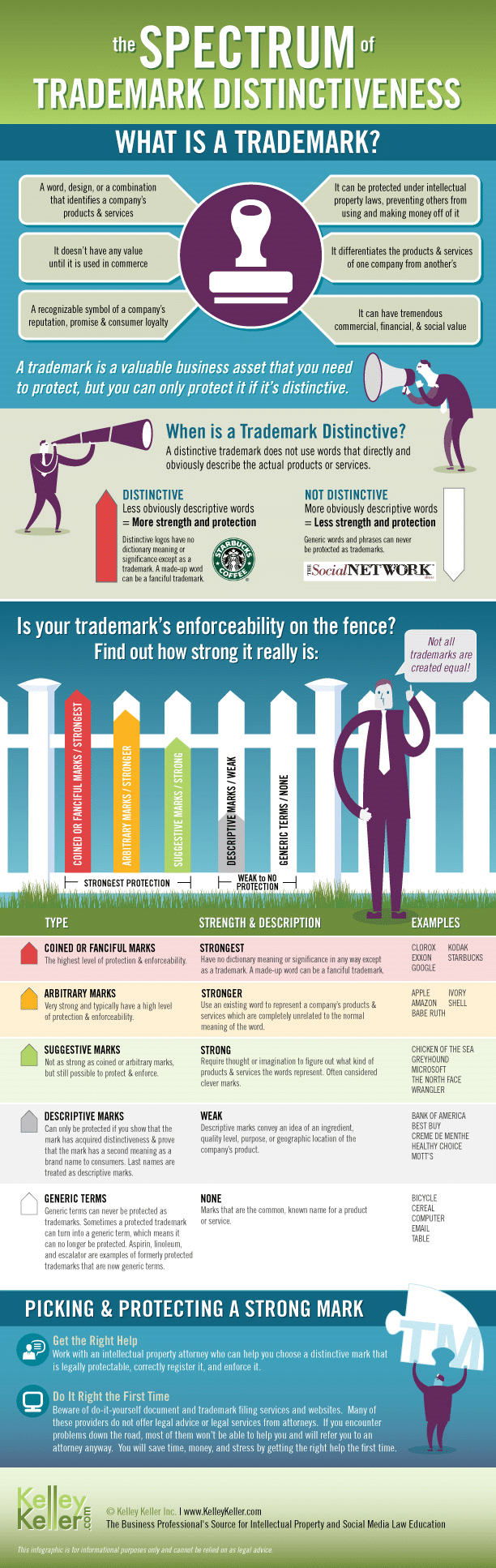
In trademark law, you can get varying levels of protection for your marks based on how distinctive they are. It can get confusing, so Women on Business contributor Kelley Keller, Esq. developed The Spectrum of Trademark Distinctiveness infographic (shown below) to help you make sure you choose strong marks that qualify for maximum levels of protection in the future.
Think of the spectrum of trademark distinctiveness as a fence that your mark needs to climb over. On one side of the fence are marks that cannot be protected or have very little legal protection. On the other side of the fence, are marks that can be protected to varying degrees. You want to not only get over the fence but as far past it as possible.
It’s also important to point out that the way your trademark application is completed can have an impact on the protectability of your mark. Beware of do-it-yourself services because just getting a trademark registration doesn’t necessarily mean that you’ll be able to fully protect it in the future.
Distinctiveness is just one factor that could affect your mark’s protectability, so be very careful. Making mistakes up front could cost you a huge amount of time, money, stress, and heartache in the future.
You can follow the link to read more about The Spectrum of Trademark Distinctiveness and view it below.
Source: Kelley Keller, Esq. via KelleyKeller.com
